Ethix Water Knowledge Centre · India Guide 2026
Drinking Water TDS in India: Ideal Levels, BIS Limits & What Your Meter Really Tells You
Drinking water TDS measures the total dissolved substances in water, but it does not tell you whether that water is free from germs, arsenic, lead or other harmful contaminants. In India, BIS IS 10500:2012 lists 500 mg/L as the acceptable TDS limit and 2,000 mg/L as a conditional permissible limit when no alternative source is available. This guide explains the numbers without calling any one TDS reading automatically safe or unsafe.
Reviewed against published BIS/WHO guidance · 18 November 2026
There is no single TDS number that guarantees safe drinking water. Under BIS IS 10500:2012 as reproduced by India's Ministry of Jal Shakti, TDS of up to 500 mg/L meets the acceptable TDS criterion; up to 2,000 mg/L is the permissible limit in the absence of an alternate source. All other chemical and microbiological quality requirements still matter. The WHO does not set a health-based guideline value for TDS itself.
1. What Is Drinking Water TDS? Full Form and Meaning
TDS stands for Total Dissolved Solids. It describes the total concentration of dissolved substances, including salts and minerals, in a water sample. Common contributors include calcium, magnesium, sodium, potassium, bicarbonates, chlorides and sulphates. A laboratory may report TDS as milligrams per litre (mg/L); for dilute water solutions, readings are commonly discussed as parts per million (ppm), approximately equal numerically.
A handheld “TDS meter” usually measures electrical conductivity and converts the reading to an estimated TDS value using a conversion factor. It does not count every substance directly. Two waters with the same displayed TDS can contain very different combinations of ions and can have very different safety profiles.
Why does drinking water TDS change?
Borewell mineral geology, municipal blending, tanker supply, source-water seasonality and treatment such as reverse osmosis can all change a reading. The same household may see different results between its raw tank, kitchen tap and RO outlet. Measure and label each sample rather than assuming one city has one fixed TDS number.
2. Drinking Water TDS Chart: BIS Limits in India
The chart below reflects the TDS parameter in IS 10500:2012. It is not a drinking-water safety certificate or a substitute for the complete standard and water testing.
| TDS reading (mg/L, approximately ppm) | How to interpret it | What to do |
|---|---|---|
| 0–500 | At or below the BIS acceptable limit for TDS alone. | Still confirm microbiological and relevant chemical parameters; do not label it “safe” from TDS alone. |
| Above 500 to 2,000 | Exceeds the acceptable TDS limit. The 2,000 mg/L limit applies only in the absence of an alternate source. | Request a laboratory report, review taste, individual ions and suitable treatment or an alternative source. |
| Above 2,000 | Above the conditional permissible TDS limit. | Arrange full water-quality assessment and identify an appropriate alternative or engineered treatment. |
Is there a WHO-recommended “perfect” drinking water TDS level?
No universal health-based “ideal TDS” band is provided by WHO. Taste and acceptability can change as dissolved minerals increase, but a pleasant-tasting sample may still fail health-related tests. Do not treat online claims such as “only 150–250 ppm is safe” as a substitute for the BIS standard or laboratory testing. See WHO's TDS chemical fact-sheet overview.
3. Is 50, 100, 300, 600 or 1,000 TDS Good for Drinking?
These common search questions are best answered by separating the TDS number from the rest of the water analysis.
| Example result | What the number alone tells you | Next check |
|---|---|---|
| 25–50 ppm | Low dissolved-ion content; common in some purified waters. Not proof of either health harm or safety. | Verify the source, treatment system and microbial quality. |
| 100–150 ppm | Below the 500 mg/L acceptable TDS limit. | Confirm other drinking-water parameters; don't call it automatically “ideal”. |
| 300–500 ppm | Within or at the BIS acceptable TDS limit. | Check hardness, source history and any relevant chemical or microbiological risks. |
| 600–1,000 ppm | Above the acceptable TDS limit; investigate the dissolved constituents. | Get a lab test and review an alternate source or treatment design. |
| 1,200–2,000 ppm | Within the conditional permissible range for TDS, but not within the acceptable range. | Do not assume general approval; seek professional testing and advice. |
| Over 2,000 ppm | Exceeds the conditional TDS limit in IS 10500. | Investigate an alternative supply or appropriately designed treatment. |
These are interpretation examples rather than medical risk categories. Safety depends on what is dissolved in the water and whether harmful microorganisms or contaminants are present.
4. How to Check Drinking Water TDS at Home
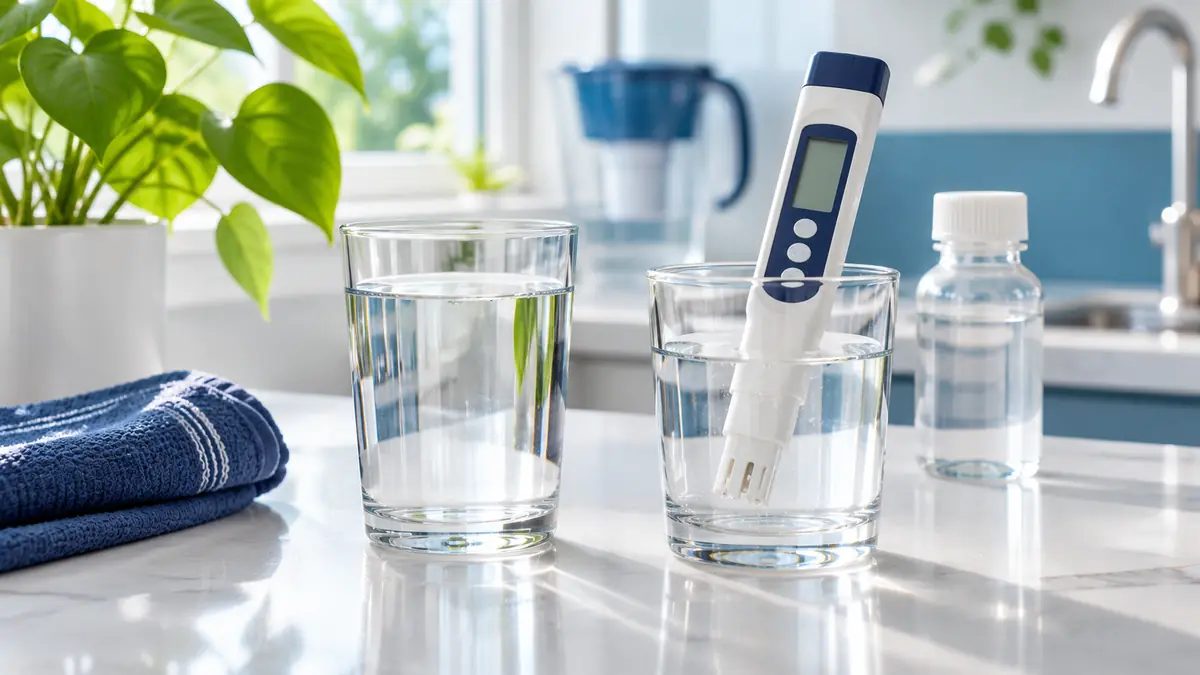
A calibrated handheld conductivity/TDS meter is useful for screening trends between water sources. It cannot replace a certified laboratory analysis.
- Use a clean glass or sample container and take water from the tap or purifier outlet you want to assess.
- Rinse the meter probe according to its manual and immerse it only to the marked depth.
- Wait until the reading stabilises. Note whether the meter uses automatic temperature compensation.
- Record the value, sample location, date and whether water came from municipal, borewell, tanker or RO supply.
- Compare like-for-like samples over time. If the reading changes unexpectedly, check calibration and repeat the test.
- For a drinking-water decision, request laboratory testing for the relevant chemical and microbiological parameters.
TDS meter vs laboratory TDS test
Many pocket meters estimate TDS from conductivity. Laboratory methods may use different measurement principles and can test individual constituents. In particular, a TDS meter cannot tell whether the dissolved material is calcium, sodium, arsenic or nitrate. For a serious water-quality concern, identify the substance by suitable lab testing.
5. Why a Good Drinking Water TDS Reading Does Not Guarantee Safety
Safe drinking water requires much more than meeting one number. India's drinking-water specification addresses parameters such as microbiological quality, arsenic, fluoride and nitrate in addition to TDS. The Ministry of Jal Shakti lists E. coli and coliform bacteria as parameters that must not be detected in a specified sample quantity under the cited standard.
What a TDS meter can indicate
- Approximate dissolved-ion concentration
- Changes after an RO membrane
- Possible source-water or purifier trend changes
What it cannot establish
- Whether E. coli or pathogens are present
- Whether arsenic, lead or nitrate exceeds its own limit
- Whether water is safe for infants or medically vulnerable users
- Whether a purifier meets all necessary water-quality requirements
If the water comes from a borewell or tanker, has unusual odour or colour, or there has been flooding or a sanitation incident, request a laboratory report suited to the source and risks. Government-supported water-quality laboratories and field-testing programs are described by the Ministry of Jal Shakti.
What should a complete drinking-water report cover?
Ask a qualified laboratory to recommend appropriate tests, which may include TDS, pH, total hardness, alkalinity, chloride, fluoride, nitrate, iron, arsenic and microbiological indicators based on local source-water risks. A specific sample need not require every test in every situation; the objective is to evaluate the actual risk, not only the TDS.
6. RO vs Water Softener vs Ethix Conditioner: Which Changes TDS?
These products have different roles. The correct selection begins with the untreated water report and the quality required at the outlet—not with the highest TDS number alone.
| Technology | Primary job | Does it lower TDS? | Important point |
|---|---|---|---|
| Reverse osmosis (RO) | Removes a substantial portion of many dissolved salts through a membrane. | Usually yes, when designed and operating properly. | Requires suitable pretreatment, maintenance and reject-water management; final safety depends on complete design and testing. |
| Ion-exchange water softener | Reduces measured calcium and magnesium hardness. | Not normally used to reduce overall TDS. | Exchanges hardness ions for sodium or potassium; uses salt/brine regeneration. |
| Ethix salt-free Water Conditioner | Designed to help reduce scale deposits in pipes and equipment. | No. | Does not remove dissolved hardness, pathogens or toxic substances; it is not a drinking-water purifier. |
| Sediment filtration | Traps suspended particles such as sand and rust. | Generally no meaningful dissolved-salt removal. | Does not address dissolved hardness or most dissolved chemicals. |
| UV disinfection | Inactivates susceptible microorganisms under correct conditions. | No. | Requires suitable water clarity, lamp performance and system design. |
Ethix provides different water-treatment solutions for different jobs. Learn about resin-based water softeners, hard-water scale problems, and Ethix Water Treatment solutions, including RO systems. A salt-free conditioner should never be presented as a substitute for drinking-water purification.
7. What to Do if Your Drinking Water TDS Is High or Low
If your TDS is above 500 mg/L
First confirm the reading with a calibrated meter or lab sample. Ask for a chemical and microbiological assessment appropriate to the source. Review alternatives and choose treatment based on what actually needs removal. An RO system may be appropriate for certain dissolved-solids problems, but not every water problem requires RO.
If your RO water shows very low TDS
Do not assume that a low reading is automatically harmful. Check the purifier manufacturer’s instructions, outlet-water report, taste and any specific medical advice. If the water tastes flat, remineralisation may be considered for taste or formulation reasons, but it must not be sold as proof of a universal medical TDS requirement.
If your water has scale but its TDS seems normal
Test hardness separately. Even water within the acceptable TDS range can leave scale, depending on calcium, magnesium, alkalinity and heating conditions. Check the Ethix hardness calculator and select a scale-management or true-softening approach according to the outcome needed.
A practical checklist before buying a treatment system
- Identify your raw-water source and test point.
- Collect a suitable laboratory water-quality report.
- Decide whether the goal is drinking-water purification, true hardness reduction, or scale deposit reduction.
- Size equipment for daily demand, peak flow and piping.
- Verify installation, wastewater, operating costs and after-sales maintenance.
- Retest treated water for the parameters that matter.
8. Drinking Water TDS Frequently Asked Questions
What is the full form of TDS in water?
Total Dissolved Solids. It is a concentration measure for dissolved material in water and does not identify each component.
What is the ideal TDS for drinking water in India?
There is no single TDS value that proves water is safe. BIS IS 10500:2012 lists 500 mg/L as the acceptable TDS limit and 2,000 mg/L as the conditional permissible limit only where no alternate source exists. Other water-quality limits still apply.
Is 100 TDS good for drinking water?
100 mg/L is below the BIS acceptable TDS limit, but this alone cannot confirm safety. Microbiological and other relevant chemical parameters must also meet applicable standards.
Is 300 TDS safe for drinking?
300 mg/L is within the acceptable TDS criterion. It is not a guarantee against bacteria or specific contaminants; source history and testing remain important.
Is 600 TDS safe for drinking water?
600 mg/L exceeds the BIS acceptable TDS limit. The source needs assessment; the conditional 2,000 mg/L limit is not an automatic declaration of safety.
Is 1,000 ppm water safe?
Its TDS is above the acceptable limit. Have the water tested for its dissolved constituents and for microbiological quality, then review an alternative source or suitable treatment.
Is drinking water TDS below 50 ppm harmful?
A low TDS reading by itself does not establish harm. Consider the complete water composition and safety tests, not a rigid “minimum ppm” claim.
Does boiling water reduce TDS?
No. Boiling does not remove dissolved salts; evaporation may leave the remaining water more concentrated. Boiling can address some microbial hazards under proper guidance, but not dissolved chemical contamination.
Does a water softener reduce TDS?
A standard ion-exchange softener reduces calcium and magnesium hardness but generally does not lower total dissolved solids in the way RO does.
Does Ethix Water Conditioner reduce TDS?
No. Ethix Water Conditioner is a salt-free scale-conditioning product. It does not lower TDS, remove hardness ions, disinfect water or make unsafe water potable.
How often should I test drinking water?
Frequency depends on source, local risks, seasonality, past results and treatment equipment. Retest whenever the source changes or there is a suspected contamination event; follow local guidance for routine testing.
Why do my kitchen tap and RO outlet have different TDS readings?
The RO membrane can reduce many dissolved ions, so its outlet often reads lower. A TDS difference alone does not establish that all microbial or chemical safety requirements are met.
9. Sources and Further Reading
This guide is based on published public-health and water-quality references, not a claimed clinical benefit from any particular treatment product.
Need Help Understanding Your Water Test Report?
Share your city, water source, full laboratory report, daily consumption and treatment goal. The Ethix team can help you compare RO, true water softening and salt-free scale-conditioning options—without confusing one technology with another.
Editorial note: This article provides general water-quality information, not a laboratory certification or medical diagnosis. Test and treat drinking water based on relevant local standards and actual contaminants.