Salt Free Water Conditioner vs Water Softener: 5 Checks Before You Buy in India
Ask five neighbors what they use for hard water and you'll hear five different answers, and half of them will call it a "softener" even when it isn't one. The two technologies solve different problems. Here's how a salt free water conditioner differs from a softener, which one you actually need, and the cases where we'd tell you to look at a salt-based softener instead.
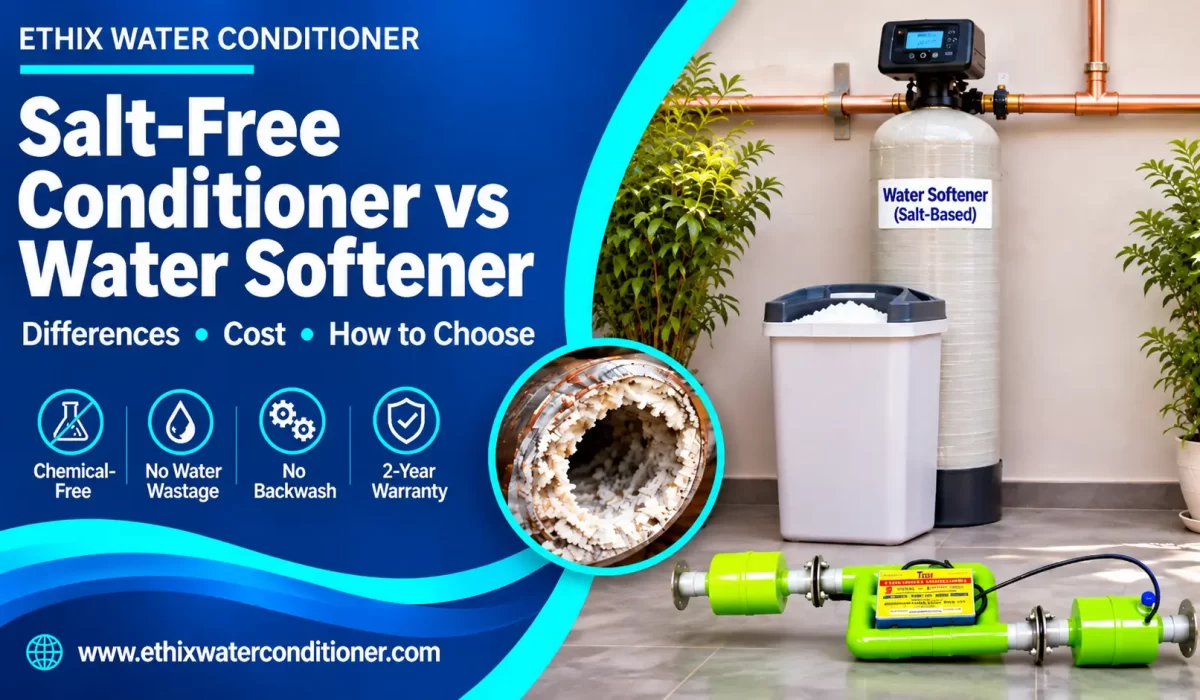
A salt-based water softener removes calcium and magnesium from the water using ion exchange, so you get truly soft water. A salt free water conditioner leaves the minerals in the water and is designed to help reduce scale buildup in pipes, taps, geysers and equipment, without salt, chemicals or drain water. If your main goal is scale protection with almost no upkeep, a conditioner is usually the practical pick. If you want the slippery, soap-friendly feel of soft water on your skin and clothes, a softener does that job more directly.
- Softener = removes calcium and magnesium (soft water). Conditioner = leaves minerals in, helps reduce scale.
- Ethix is salt-free, chemical-free and uses no water for regeneration. It is not RO and does not reduce TDS.
- Choose a softener for skin, hair and laundry comfort. Choose a conditioner for protecting pipes, geysers, fittings and equipment with minimal upkeep.
- Test total hardness (mg/L as CaCO₃) before buying. TDS cannot tell you hardness.
- Size by pipe diameter and pump HP, not by number of bathrooms.

Why everyone mixes these two up
In India, "water softener" has become the catch-all word for anything you fit on a water line to deal with white scale. Sellers use it, buyers search for it, even we use it in some of our page titles because that's what people type into Google.
But the word hides a real difference. One device changes the water's chemistry. The other changes how the hardness minerals behave once they're in your pipes. If you buy one expecting the other, you'll end up disappointed, and that's not a fault of the product, it's a fault of the explanation.
So let's explain it properly.
How a salt-based softener works
A conventional softener is a tank filled with resin beads. As hard water flows through, the resin grabs calcium and magnesium and releases sodium in their place. What comes out is soft water: it lathers easily, rinses clean and doesn't leave chalky marks as it dries.
The catch is that the resin fills up. Every few days (sometimes every day in a busy household), the system flushes itself with a strong salt solution called brine to recharge the resin. That cycle is why a softener needs:
- Salt, refilled regularly and stored somewhere dry
- A drain point, because the flushing sends salty wastewater out
- Power or a mechanical valve to run the regeneration
- Resin that eventually ages and needs replacing
None of that is a dealbreaker. Lots of homes run softeners happily for years. It just means you're signing up for a small ongoing routine.
How a salt free water conditioner works
A salt free water conditioner like Ethix Water Conditioner takes a different route. It's an electronic hard-water conditioning system fitted on the water line. It doesn't remove calcium or magnesium, doesn't use resin, and doesn't add anything to the water. The idea is to help the dissolved minerals pass through your plumbing without building up as hard scale on pipe walls, fittings and heating surfaces.
That's why it needs no salt, no brine and no drain, and why it can go on an existing pipeline. The right model and the right spot depend on your pipe diameter, pump capacity and what you're protecting.
Let's be straight about the limits. A salt-free conditioner is not an RO system and does not reduce TDS. The minerals are still in your water, and a TDS meter will read about the same before and after. What you should expect to change over time is how much scale-related trouble you see, and that depends on your hardness level, existing scale, usage and plumbing condition. Results tend to show up gradually, not overnight.
Salt free water conditioner vs softener: side-by-side comparison
| Salt-based softener | Salt-free conditioner (Ethix) | |
|---|---|---|
| What it does | Removes calcium and magnesium; delivers soft water | Leaves minerals in; designed to help reduce scale formation |
| Water feel | Noticeably soft and slippery | Feels like your normal water |
| Salt needed | Yes, refilled regularly | No |
| Wastewater | Yes, from regeneration | No water wasted |
| Chemicals | Salt brine for recharging | No chemical dosing |
| Ongoing upkeep | Salt, resin, valve and drain checks | Basic inspection and a proper electrical connection |
| Changes TDS? | Not meaningfully (swaps ions, doesn't remove them) | No |
| Installation | Needs space, drain and salt storage | Fits on an existing pipeline |
| Best known for | Soap, skin, hair and laundry comfort | Protecting pipes, taps, geysers and equipment from scale |
When a softener is the better call
We sell conditioners, so you'd expect us to say they win every time. They don't. A salt-based softener is probably the better fit when:
- Comfort is the main reason you're buying. If dry skin, stiff towels or soap that won't lather are what's bothering you most, truly soft water addresses that directly. Our posts on hair and skin explain what hard water can and can't be blamed for.
- You're happy to manage salt. If refilling a salt tank every few weeks doesn't bother you, the routine is easy.
- You have a drain point and floor space near the water entry line.
- Your plumbing already has a lot of old scale and you want to start from soft water. (Either way, an existing buildup won't vanish overnight, and heavy deposits may need separate cleaning.)
When a salt free water conditioner makes more sense
A salt-free conditioner tends to suit people whose real headache is what scale does to hardware:
- Geysers, solar heaters and bathroom fittings that clog, slow down or look dull within a year or two. See what scale does in a geyser, a solar water heater, the bathroom and a washing machine.
- Borewell or tanker supply with high hardness where a society, farm or factory would otherwise be handling salt in bulk.
- Large or multi-point installations such as housing societies, hotels, hospitals, cooling towers, boilers and drip lines, where regeneration cycles and drains get awkward. Related reading: cooling towers, boilers, drip irrigation and hotels. Sector pages: residential, commercial, industrial and agriculture.
- Places where water is precious. No regeneration means no wastewater, which matters in tanker-dependent areas.
- Anyone who simply doesn't want another chore. Honestly, a lot of buyers land here.
Our range reflects those use cases: the Delta Series for small homes and bungalows, the Delta Plus Series for residential, commercial, industrial and agriculture sectors, the Bramhastra Series for bathrooms and kitchens, and the Scale Jammer for industrial pipelines and equipment.
The cost nobody puts on the quotation
When people compare the two, they compare the sticker price. That's the smaller half of the story. Over a few years, what really separates them is what you keep paying for:
With a salt-based softener, think about
- Salt bags, again and again
- Resin replacement down the line
- Drain water lost with every regeneration
- Service visits for the valve and controller
With a salt-free conditioner, think about
- A correctly sized unit for your pipe and pump
- A proper electrical connection and surge protection
- Occasional inspection
- A realistic expectation: it manages scale, it doesn't soften
We're deliberately not putting rupee figures here. Prices depend on model, pipe size, pump HP, flow and site conditions, so any number we printed would be wrong for most readers. Our sizing and cost guide explains what drives the quote.
Five things to sort out before you buy
- Measure your hardness properly. A TDS meter can't tell you this. A low TDS reading can still be hard water, and a high one might not be. Ask a lab or a proper test kit for total hardness in mg/L as calcium carbonate. Our guide on testing water hardness at home walks through it, and hard water vs TDS explains why the meter misleads.
- Be clear on your real problem. Is it scale on fittings and geysers, or skin and laundry comfort, or both? Write it down. The answer usually points to one technology or the other.
- Know your pipe size and pump HP. Any honest supplier will ask for these. If nobody does, be careful.
- Decide where it will sit. Main inlet, after the overhead tank, or at a specific bathroom or equipment line? Position changes what gets protected.
- Separate drinking water from scale control. Neither a softener nor a conditioner replaces an RO or purifier if your drinking water needs that. They solve different problems.
Mistakes we see again and again
- Buying on TDS alone. It's the most common reason people pick the wrong solution.
- Expecting a conditioner to feel like a softener. The water will taste and feel like the water you already have. The difference shows in taps, showerheads and heating elements, not in the glass.
- Undersizing to save money. A unit that's too small for your pipe or flow won't do its job, whichever technology you pick.
- Ignoring old scale. Existing deposits in pipes and geysers don't disappear the day you install anything. Plan for a clean-out where scale is heavy.
- Skipping the electrical basics. A conditioner needs a proper connection and protection from voltage surges. It's cheap insurance.
Water terms explained in plain words
- Hard water
- Water carrying a lot of dissolved calcium and magnesium. It's common with borewell, tanker and mineral-rich groundwater.
- Total hardness
- The number labs report, in mg/L as calcium carbonate (CaCO₃). As a rough guide, up to 60 mg/L is considered soft, 61 to 120 moderately hard, 121 to 180 hard, and above 180 very hard. India's drinking water standard, IS 10500, lists 200 mg/L as the acceptable limit and 600 mg/L as the permissible limit where no better source is available.
- Scale (limescale)
- The hard white or grey crust that forms on taps, showerheads, geyser elements and pipe walls, mostly calcium carbonate.
- Ion exchange
- The process inside a salt-based softener where resin swaps calcium and magnesium for sodium.
- TDS
- Total dissolved solids. It counts everything dissolved in the water, not only hardness minerals, so it can't tell you how hard your water is.
- Reverse osmosis (RO)
- A membrane purification method that lowers TDS. It's a drinking-water tool and a different job from scale control. Hard water can actually foul RO membranes, which is covered in our RO scaling guide.
Hardness bands and IS 10500 limits are quoted from commonly published references. Check the latest BIS and your local water authority guidance for official values.
Questions we get asked most
Is a salt free water conditioner the same as a water softener?
No. A softener removes calcium and magnesium using ion exchange. A salt-free conditioner leaves them in and is designed to help reduce scale buildup in pipes, taps, geysers and equipment.
Does a salt-free conditioner reduce TDS or hardness?
No. Ethix is not an RO system and does not reduce TDS. Minerals remain in the water. What it's designed to do is help manage scale-related problems.
Which is better for borewell water, a softener or a conditioner?
It depends on what you want. For protecting pipes, geysers, fittings and equipment without handling salt or wasting water, a conditioner is a practical choice. For the feel of soft water on skin and laundry, a softener is more direct. Our page on borewell hard water problems goes deeper on what borewell supply does to a home.
Can it be installed on an existing pipeline?
Yes. Ethix Water Conditioner can be installed on an existing water line. The size and installation point are selected according to pipe diameter, pump capacity and application.
What maintenance does a salt-free conditioner need?
No salt refills, no resin regeneration and no chemical dosing. Basic inspection and a proper electrical connection are recommended as per installation guidance.
How soon will I see results?
It varies with your water hardness, how much scale is already there, your usage and the plumbing condition. Improvement in scale-related issues is usually gradual, not immediate.
Does it work for housing societies and farms, or only homes?
Ethix is made for homes, apartments, societies, hotels, hospitals, industries and agriculture. Larger sites need correct sizing by flow and pipe diameter. See our notes on hard water solutions for housing societies.
The short version
If you want soft water, buy a softener. If you want your pipes, taps, geysers and equipment to stop silting up, and you don't want to deal with salt, drains or chemicals, a salt free water conditioner is built for exactly that. And if you're torn between the two, get your water tested first. That one step settles most of these debates.
Not sure which one fits your site?
Tell us your water source, city, pipe size and what you want to fix. We'll suggest the right Ethix model and where to install it. If a different approach suits you better, we'll say so.
Get free consultation Call 1800-123-6463 WhatsApp usWritten by the Ethix Water Conditioner team at Emerging Ethix Power Pvt. Ltd., Pune. This article is general guidance. Actual results depend on your water quality, plumbing and installation, so we recommend a water test before choosing any system.