
Water Quality Guide
Hard Water in Washing Machine: Why It Matters
Hard water contains dissolved calcium and magnesium. During washing—especially at higher temperatures—these minerals can react with detergent, reduce lather and contribute to deposits on the drum, inlet path and heating components. Clothes may feel stiff or look dull even when the appliance itself appears normal.
Hard water can affect both laundry results and washing-machine maintenance. Common clues include poor detergent performance, white residue, stiff-feeling clothes and recurring scale. Confirm hardness with a proper test before selecting a softener, conditioner or other treatment.
1. Signs of Hard Water in a Washing Machine
One symptom is not enough to diagnose a hardness problem. Look for several consistent signs in the laundry area and elsewhere in the property.
- White, chalky deposits around the inlet, detergent drawer, drum or nearby tap.
- Detergent produces less lather or leaves visible residue.
- Clothes feel stiff, rough or less fresh after drying.
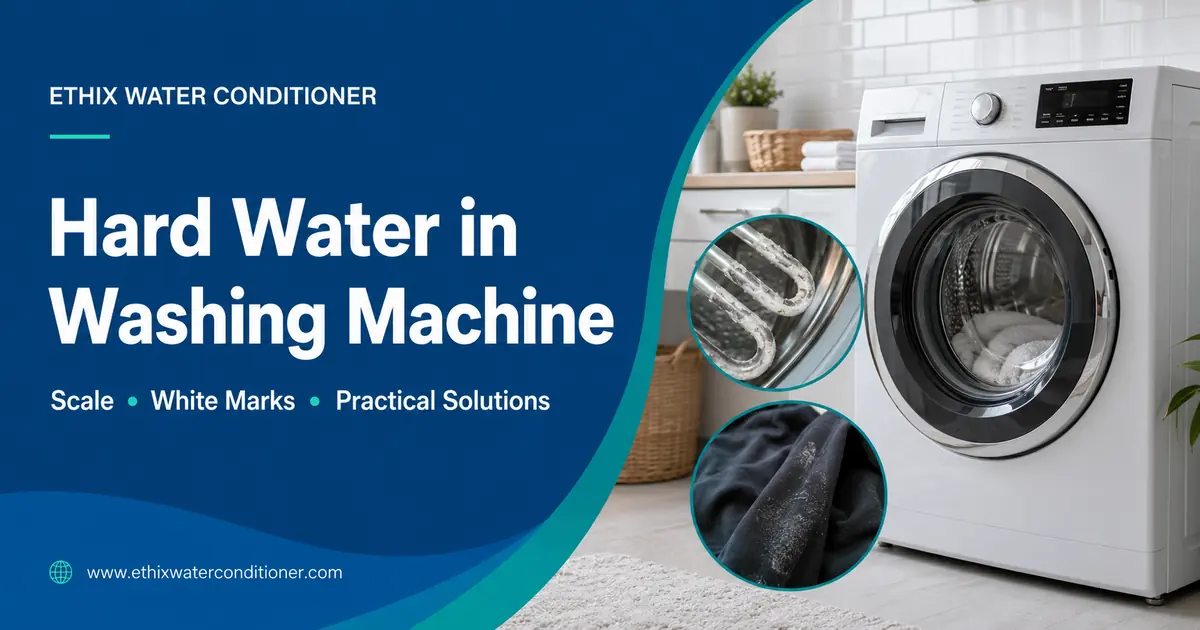
- Dark fabrics show pale spots or powdery marks.
- Towels gradually lose softness and absorbency.
- Wash quality declines even after adjusting the detergent dose.
- A heated cycle takes longer or an authorised technician finds scale on the heater.
How scale can affect internal parts
Mineral deposits may accumulate on surfaces that repeatedly contact heated water. In front-load and fully automatic machines, the heating element, water inlet, drum area and hoses may be affected depending on the appliance design. Scale can interfere with heat transfer and may increase cleaning or service needs, but a slow or failed cycle can also result from electrical, sensor, drainage or mechanical faults.
Do not open the machine to inspect internal components yourself. Disconnect power before accessible cleaning and use an authorised technician for internal inspection or repair.
2. How to Confirm Whether Hard Water Is the Cause
Test total hardness—not only TDS
A TDS meter estimates total dissolved ions but does not separately identify calcium and magnesium. Use a total-hardness kit or laboratory report, expressed in mg/L as CaCO₃, when hardness is the concern. Learn more in our hard water vs TDS guide.
| Observation | Possible cause | What to check |
|---|---|---|
| White marks on dark clothes | Mineral or detergent residue; overloaded drum | Hardness, detergent dose, load size and rinse setting |
| Stiff towels | Hardness residue, excessive detergent or fabric softener buildup | Product dose, rinse performance and water report |
| Bad smell in washer | Moisture, biofilm, trapped lint or drainage issue | Door seal, filter, drain and cleaning cycle |
| Slow filling | Blocked inlet screen, low pressure or valve fault | Pressure, hose, inlet filter and service diagnosis |
| Slow heating or error code | Scale, heater, sensor or electrical fault | Authorised technical inspection |
Check the pattern across the home
If taps, showerheads, bathroom tiles and the geyser also develop white scale, hardness is more likely to be a property-wide issue. If only the washing machine is affected, first rule out detergent choice, overloading, blocked filters, drainage and appliance maintenance.
- Water source: borewell, tanker or municipal supply
- Total hardness and TDS from the same sample
- Washing-machine type and manufacturer guidance
- Cold-only or internally heated wash cycle
- Detergent type, dose, load size and visible residue
3. How to Clean and Prevent Washing-Machine Scale
Safe maintenance steps
- Follow the cleaning cycle and descaling instructions in the appliance manual.
- Use only a cleaner approved for the machine; do not mix acids, bleach or other chemicals.
- Clean accessible inlet screens, detergent drawers, door seals and filters as instructed.
- Use detergent formulated for automatic machines and dose it according to hardness and load.
- Avoid overloading so water and detergent can circulate and rinse properly.
- Arrange authorised service if error codes, leakage, abnormal noise or heating problems continue.
Select treatment based on the required result
| Requirement | Typical option | Important limitation |
|---|---|---|
| Physically reduce calcium and magnesium | Ion-exchange softener | Needs salt, regeneration, drainage and maintenance |
| Remove sand, rust or suspended matter | Sediment or media filter | Does not remove dissolved hardness by itself |
| Reduce dissolved salts for drinking | Suitably selected RO purifier | Usually point-of-use; not normally sized for all laundry water |
| Manage scale behaviour without salt | Salt-free water conditioner | Does not reduce laboratory hardness or TDS readings |
Where several bathrooms, geysers and appliances show the same scale problem, a correctly sized main-line solution is generally more practical than treating only one washing-machine inlet. Selection depends on water quality, flow, pipe size and consumption.
4. Where Ethix Water Conditioner May Fit
Ethix Water Conditioner is designed for salt-free scale management in residential plumbing and connected equipment. It may suit homes seeking a chemical-free, media-free alternative without salt regeneration, particularly when scale occurs at multiple outlets.
Ethix does not remove calcium and magnesium, does not reduce TDS, and is not a drinking-water purifier. Performance should be assessed through practical observations such as scale behaviour, cleaning frequency and the condition of connected fixtures and equipment—not by expecting a lower hardness or TDS test value.
Correct model selection requires pipe size, pump capacity, source water, daily consumption and installation-point details. Read how to choose a water conditioner for home or explore the Ethix residential solution.
Frequently Asked Questions
Can hard water damage a washing machine?
Hardness minerals can contribute to scale on water-contact and heating parts, which may increase maintenance needs. Not every fault is caused by hard water, so appliance diagnosis remains important.
Why do white marks appear on dark clothes?
Possible causes include mineral residue, undissolved detergent, excessive product, overloading or poor rinsing. Test hardness and review the wash settings before assuming one cause.
Does liquid detergent work better in hard water?
Liquid detergent may reduce undissolved powder residue, but correct dosing still depends on hardness, load size, soil level and manufacturer instructions.
Can vinegar be put in every washing machine?
Do not assume so. Acids can affect seals or components in some machines. Follow the specific appliance manual and use only approved cleaning products.
Will a sediment filter stop washing-machine scale?
No. A sediment filter removes suspended particles but normally does not remove dissolved calcium and magnesium responsible for hardness scale.
Does Ethix reduce hardness or TDS?
No. Ethix is designed to manage scale behaviour without salt or chemicals; it does not claim to reduce laboratory hardness or TDS readings.