Water Quality Guide • Borewell Water • India
Borewell Hard Water Problems in India: Causes, Signs & Right Solutions
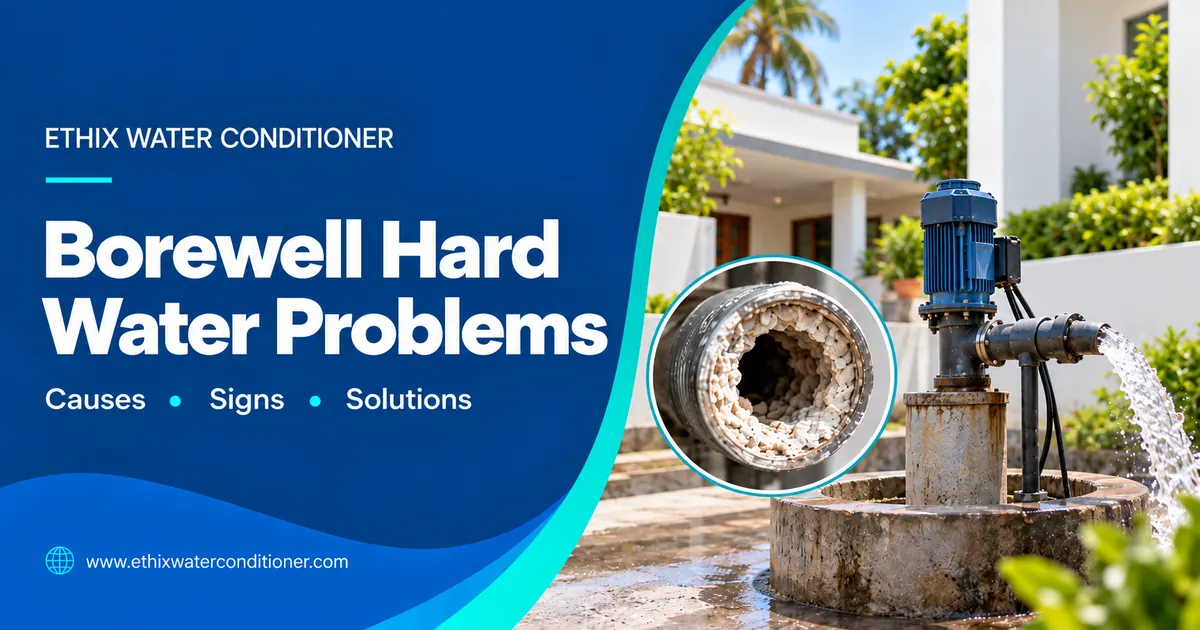
If your home, bungalow, apartment, housing society, hotel, factory or farm depends on borewell water, you may already have noticed white deposits on taps, blocked showerheads, scale inside geysers, dull bathroom fittings or recurring plumbing maintenance. These can be common signs of borewell hard water and mineral scale.
But there is an important point many people miss: hardness and TDS are not the same thing, and every borewell-water problem should not be treated with the same technology. Before choosing a system, identify whether your actual requirement is scale management, hardness reduction, TDS reduction, filtration or drinking-water purification.
Quick Answer: What Is the Right Solution for Borewell Hard Water?
Borewell water can contain dissolved calcium and magnesium that contribute to hardness and scale formation. The right solution depends on the result you need:
- Need actual hardness reduction? A resin-based ion-exchange water softener may be required.
- Need scale management without salt or resin? A water conditioner may be considered.
- Need drinking-water TDS reduction? RO may be required after proper water testing.
- Have iron, sand, turbidity or other contaminants? Additional treatment or filtration may be required.
- Concerned about drinking-water safety? Test the water and select purification according to the report.
Ethix Water Conditioner is designed for hard-water scale management. It is not an RO purifier and does not reduce TDS. Learn more on the Ethix Borewell Water Conditioner in India page.
What Is Borewell Hard Water?
Groundwater travels through soil and geological formations before it reaches a borewell. During this process, naturally occurring minerals can dissolve into the water. Calcium and magnesium are the principal minerals associated with water hardness.
The water can still look clear while creating scale later on taps, showerheads, geysers, solar water heaters, valves, pipelines and other water-using equipment. If you want to understand the basic test before buying any treatment system, read our guide on how to test water hardness at home.
Why Can Borewell Water Become Hard?
Borewell-water chemistry depends on local geology, aquifer conditions, bore depth, recharge, season and surrounding environmental conditions. Two borewells in the same region can therefore produce water with different chemical characteristics.
The Central Ground Water Board’s Annual Ground Water Quality Report 2025 evaluates groundwater using parameters including calcium, magnesium, total hardness, chloride, fluoride, nitrate, iron and other constituents. This is one reason a complete treatment decision should not be based only on a handheld TDS reading.
Water source + total hardness + TDS + other relevant test parameters + visible problem + application + pipe size + pump/flow conditions.
10 Common Signs of Borewell Hard Water
1. White Scale on Taps
A white or chalky deposit around faucets can be an indication of mineral deposition. If it keeps returning after cleaning, test the water hardness.
2. White Marks on Bathroom Tiles and Glass
When water droplets evaporate, dissolved minerals can remain behind and form visible spots on tiles, shower glass and fittings.
3. Showerhead Blockage
Scale can gradually restrict the small openings in showerheads, causing uneven spray or reduced flow.
4. Geyser Scaling
Heating can encourage mineral deposition, so hard water can create recurring scale concerns in geysers and hot-water systems.
5. Deposits Inside Pipelines
Scale can accumulate inside susceptible pipelines and fittings over time, increasing cleaning and maintenance requirements.
6. Tap Aerator Blockage
Small aerators can collect deposits and may require frequent cleaning in scale-prone water conditions.
7. Solar Water Heater Scaling
Hard water can create scale-related maintenance concerns on hot-water surfaces and associated pipelines.
8. Repeated Plumbing Cleaning
If showers, valves, taps and fittings repeatedly need descaling, hardness may be one of the causes.
9. Scale in Water-Using Equipment
Pumps, valves, utility lines and heat-related equipment may experience scale depending on water chemistry and operating conditions.
10. Scale in Irrigation Lines
In agriculture, mineral deposition can create maintenance concerns in pipelines, valves, sprinkler nozzles and drip components. For farm applications, see the Ethix Agriculture Water Conditioner guide.
Seeing These Signs in Your Borewell Water?
Share your city, water source, motor HP, pipe size, tank capacity and hardness/TDS report if available. The Ethix team can guide you toward the suitable application and installation point.
Hardness vs TDS: They Are Not the Same
TDS means Total Dissolved Solids and represents the combined amount of dissolved substances estimated in the water. Water hardness is primarily associated with calcium and magnesium.
Because TDS includes many dissolved ions, a normal TDS meter cannot tell you exactly how much calcium and magnesium hardness is present. Two samples can have similar TDS readings but different hardness levels.
For a detailed explanation, read Hard Water vs TDS: Can a TDS Meter Check Water Hardness?.
| Point | Water Hardness | TDS |
|---|---|---|
| Main meaning | Primarily calcium and magnesium associated with hardness | Total concentration of dissolved substances |
| Typical reporting | Often mg/L as CaCO3 | Usually mg/L or ppm |
| Can a basic TDS pen measure it? | No | Provides an approximate conductivity-based TDS reading |
| Main treatment question | Do you need hardness removal or scale management? | Do you need dissolved-solids reduction? |
How to Test Borewell Water Hardness
1. Observe the Physical Signs
Scale on taps, showerheads, heating equipment or bathroom surfaces can indicate a hardness-related issue, but visual observation cannot quantify the hardness level.
2. Use a Hardness Test Kit
A total-hardness test strip or drop-count hardness kit is more relevant for hardness than relying only on a TDS meter. Our step-by-step article explains how to test hard water at home.
3. Get a Laboratory Water Test
For housing societies, commercial buildings, factories, agriculture and drinking-water decisions, laboratory testing is the better basis for treatment design. Depending on the application, useful parameters can include:
- Total hardness
- Calcium and magnesium
- TDS / conductivity
- pH and alkalinity
- Iron and manganese
- Chloride
- Fluoride
- Nitrate
- Turbidity
- Microbiological parameters where drinking-water safety is involved
For drinking-water applications, testing and interpretation should follow appropriate drinking-water standards such as BIS IS 10500 and professional laboratory guidance.
What Can Happen If Scale-Prone Borewell Water Is Ignored?
Hard water does not automatically mean unsafe drinking water. Hardness and drinking-water safety are different questions. The practical problem associated with hardness is often recurring mineral scale and maintenance.
- Bathrooms: recurring deposits on taps, showers, glass and fittings.
- Geysers and hot-water systems: scale on heating surfaces and associated components.
- Plumbing: mineral deposits in susceptible pipelines and fittings.
- Societies: building-level complaints across multiple flats and wings.
- Agriculture: scale-related maintenance in irrigation lines, valves, nozzles and emitters.
- Commercial and industrial systems: site-specific scale concerns in water-using utility systems.
Borewell Hard Water Solution: Which Technology Do You Need?
There is no single water-treatment machine that solves every borewell-water problem. Choose the technology according to the result you actually need.
| Technology | Main Purpose | TDS Reduction? | Hardness Removal? | Typical Use |
|---|---|---|---|---|
| RO | Dissolved-solids reduction in suitable applications | Yes | Can reduce hardness in the RO-treated stream | Drinking/process water after correct design |
| Ion-Exchange Water Softener | Actual hardness reduction | Not its main purpose | Yes | Applications needing softened water |
| Water Conditioner | Hard-water scale management | No | No | Scale-prone pipelines, fittings and equipment |
| Sediment / Media Filtration | Physical impurities or selected filtration | No | No | Sand, sediment and application-specific prefiltration |
| Iron Removal System | Iron treatment | Depends on process | Not its primary purpose | Iron-related water problems |
| UV | Microbial disinfection of suitable pretreated water | No | No | Disinfection applications |
If an RO membrane is your concern, also read Hard Water in RO System: Membrane Scaling & Pretreatment.
Where Does Ethix Water Conditioner Fit?
Ethix Water Conditioner is designed for customers whose primary concern is hard-water scale management rather than TDS reduction or complete mineral removal.
It is a salt-free, chemical-free and resin-free water-conditioning option for suitable residential, housing-society, commercial, industrial and agriculture applications. Minerals remain in the water and Ethix should not be presented as a drinking-water purifier.
For a complete product/application overview, visit Ethix Water Conditioner in India.
Ethix is intended for:
- Hard-water scale management
- Borewell water lines
- Tap and shower scaling concerns
- Geyser and hot-water scale concerns
- Pipeline and water-using equipment scale management
- Suitable irrigation scale applications
- Residential through higher-flow applications after correct model selection
Ethix does not:
- Reduce TDS like RO
- Act as a drinking-water purifier
- Remove bacteria
- Remove calcium and magnesium like an ion-exchange softener
- Replace treatment required for specific contaminants
Water Conditioner vs Water Softener for Borewell Water
Traditional Ion-Exchange Water Softener
A conventional softener reduces hardness by exchanging calcium and magnesium ions through resin. It is appropriate where the application requires actual hardness reduction. Regular salt regeneration and maintenance are part of normal operation.
Ethix Water Conditioner
Ethix belongs to a different treatment category. Its role is hard-water scale management without regular salt refilling or resin regeneration.
Where Should a Borewell Water Conditioner Be Installed?
The best installation point depends on the complete water-flow arrangement. Common locations can include:
- Borewell outlet: where borewell water directly feeds the property.
- Main pump delivery line: where a common pump supplies the water system.
- Overhead tank inlet: depending on usage pattern and site configuration.
- Tank outlet / distribution line: where treatment is required before water enters the network.
- Agriculture main line: before drip or sprinkler distribution where technically appropriate.
View real application guidance on the Ethix Installation Videos & Project Gallery.
What Information Is Needed to Select the Right Ethix Model?
Do not select a model only by the size of the house. Share the following details:
- Water source: borewell, tanker, municipal or mixed.
- Motor HP: borewell or transfer pump rating.
- Pipe size: the pipeline where installation is planned.
- Property type: home, bungalow, society, hotel, factory, farm, etc.
- Tank capacity: underground and/or overhead storage.
- Approximate daily water use or flow information: where available.
- Water report: especially total hardness and TDS if tested.
- Main problem: white scale, geyser scaling, pipeline deposits, irrigation blockage, etc.
- Installation photos: borewell outlet, pump line, tank line or main pipeline.
Get the Right Model Instead of Guessing
Send your site details to the Ethix team for technical model-selection guidance.
When Is a Water Conditioner Alone Not Enough?
Borewell water can have issues other than hardness. If testing shows iron, suspended particles, excessive salinity, fluoride, nitrate, microbiological contamination or another concern, additional or different treatment may be required.
- Sand / suspended particles: suitable physical filtration may be required.
- Iron: an iron-removal process may be required depending on chemistry and concentration.
- High TDS where reduction is required: RO or another suitable process may be required.
- Microbiological contamination: suitable purification/disinfection is required.
- Actual hardness reduction: ion-exchange softening may be more suitable.
- Scale management without salt: a water conditioner may be considered.
Borewell Hard Water Solution for Homes
For an independent home, bungalow or villa, treating the common water line can be more practical than trying to manage scale independently in every bathroom. Site layout, pump HP, pipe size, tank arrangement and usage should be checked before selecting the model.
For residential hard-water solutions across India, see the Ethix water conditioner application guide.
Borewell Hard Water Solution for Housing Societies
Society systems are more complex. A typical flow can be: borewell → underground tank → pump room → overhead tank → multiple wings → flats. Proper planning should consider borewells, pump HP, pipe diameters, tanks, number of wings, daily requirement, refill cycles, mixed water sources and the selected installation point.
Borewell Hard Water Solution for Agriculture
Hard borewell water can create scale-related maintenance concerns in farm pipelines, valves, filters, drip components, sprinklers and nozzles. Model selection should consider motor HP, pipe size, irrigation method, farm layout and installation location.
See the dedicated Agriculture Water Conditioner for Farming & Irrigation Systems page for application details.
Before Buying Any Borewell Hard Water Solution, Ask These 5 Questions
- Does this technology actually remove hardness, or does it manage scale?
- Does it reduce TDS?
- Does it require salt, resin, chemicals, regeneration or wastewater discharge?
- Where will it be installed in my water system?
- Has my actual water problem been identified through observation and testing?
Need a Borewell Hard Water Solution?
If white scale repeatedly appears on taps, showers, geysers or pipelines, first confirm the water hardness and understand whether your requirement is hardness removal or scale management.
For customers whose main concern is hard-water scale, explore the dedicated Ethix Borewell Water Conditioner page or contact the team with your site details.
Talk to Ethix Water Conditioner
Share: City + Water Source + Motor HP + Pipe Size + Tank Capacity + Application + Hardness/TDS Report (if available)
Emerging Ethix Power Pvt. Ltd.
Sr. No. 54, Holkar House, 4th Floor, Near Nikhil Garden, Beside Hotel Dawat, Near Navale Bridge, Bengaluru Highway, Pune, Maharashtra – 411041
Frequently Asked Questions About Borewell Hard Water
Is borewell water always hard?
No. Borewell-water chemistry depends on local geology, aquifer conditions, depth and other factors. Testing is the best way to confirm hardness.
How do I know whether my borewell water is hard?
Recurring white deposits, scale on taps, blocked showerheads and geyser scaling can be signs. A hardness test or laboratory report gives better confirmation.
Does high TDS mean hard water?
Not necessarily. TDS represents total dissolved substances, while hardness mainly relates to calcium and magnesium. Test hardness separately.
Can a TDS meter measure water hardness?
No. A standard TDS meter does not directly measure total hardness. Use a hardness test kit or laboratory test.
Does Ethix Water Conditioner reduce TDS?
No. Ethix Water Conditioner is designed for hard-water scale management and does not reduce TDS like an RO system.
Does Ethix remove calcium and magnesium?
Ethix is not an ion-exchange softener. It does not remove calcium and magnesium hardness minerals from the water.
Is Ethix a water softener?
Ethix is a water conditioner. It is different from a conventional resin-based water softener and is intended for suitable scale-management applications.
Can Ethix be installed directly after a borewell pump?
Depending on the site layout, installation may be planned at the borewell outlet or another suitable flowing-water line. Pump HP, pipe size, tank arrangement and water flow should be checked before final selection.
Is Ethix suitable for housing societies using borewell water?
It can be considered where hard-water scale affects common water lines, tanks, plumbing, geysers and fittings. Technical selection should be based on the society’s complete water-flow system.
Can Ethix be used for agriculture borewell water?
It can be considered for scale-related concerns in irrigation pipelines, valves, drip systems and sprinklers. Other agricultural water-quality parameters should be evaluated separately.
Does a water conditioner make borewell water safe for drinking?
No. A water conditioner should not be considered a drinking-water purifier. Drinking-water treatment should be selected after appropriate water-quality testing.
Should I choose RO, a softener or a water conditioner?
Choose according to the required outcome. RO is used when dissolved-solids reduction is required, ion-exchange softeners for actual hardness reduction, and water conditioners for suitable scale-management applications.
For additional product questions, visit the Ethix Water Conditioner FAQ.
Final Takeaway
If you use borewell water and repeatedly face white scale, blocked showerheads, geyser deposits or pipeline scaling, do not select a treatment system only from a TDS reading or a generic “hard water” label.
First identify the problem. Then choose the treatment. Filtration, purification, hardness removal and scale management are different requirements.
For customers whose primary concern is hard-water scale without regular salt and resin regeneration, Ethix Water Conditioner can be considered after proper model and installation assessment.
Authoritative water-quality references: