
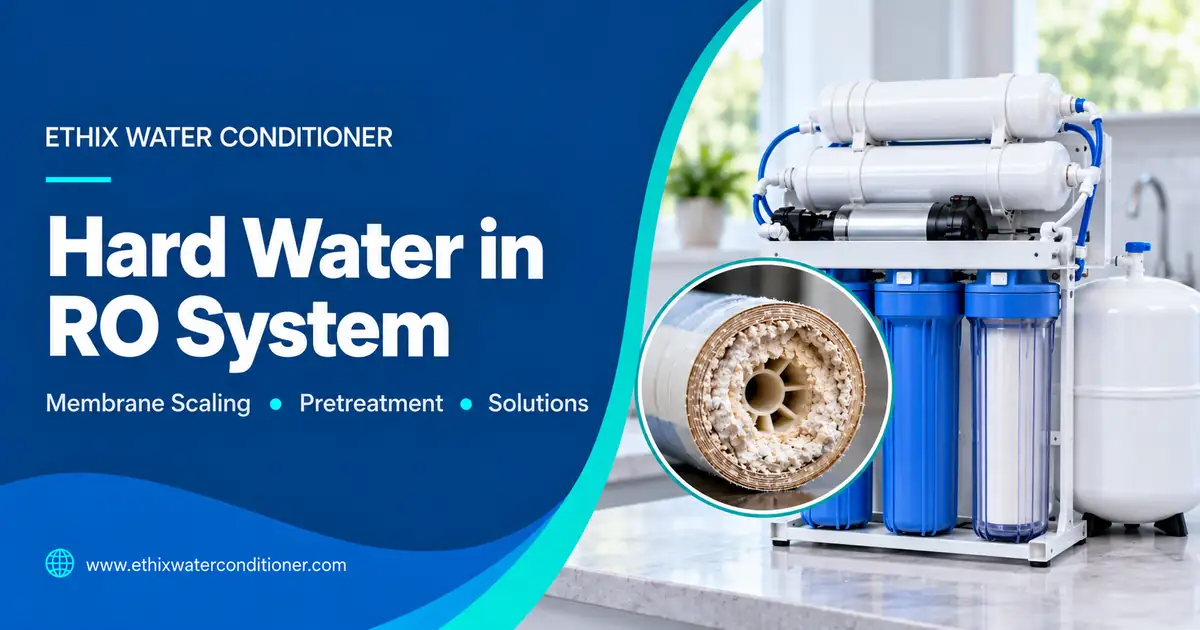
Hard Water in RO System: Membrane Scaling, Low Flow & Pretreatment Solutions
Hard water can create operating problems in reverse osmosis systems when
scale-forming minerals become concentrated near the RO membrane.
Calcium carbonate and other mineral deposits may reduce membrane performance,
increase cleaning requirements and affect treated-water production.
RO can treat hard water, but hardness must be considered during system design.
As RO separates water from dissolved salts, minerals become more concentrated
on the reject side. Under certain conditions, calcium and other compounds may
precipitate and form scale on the membrane. Correct water analysis and
pretreatment help reduce this risk.
- Why hard water affects an RO system
- What RO membrane scaling is
- Signs of membrane scaling
- Water tests required before RO
- RO pretreatment options
- Where Ethix Water Conditioner fits
- Frequently asked questions
1. Why Does Hard Water Affect an RO System?
Hard water contains dissolved calcium and magnesium minerals.
These minerals are commonly found in borewell and groundwater sources.
In a reverse osmosis system, pressure forces part of the feed water through
a semi-permeable membrane. Many dissolved salts remain on the feed side and
become concentrated in the reject or concentrate stream.
If the concentration of certain minerals becomes too high, they can begin
forming deposits on membrane surfaces.
Calcium and magnesium enter the RO system with the raw water.
RO removes permeate while salts become concentrated on the reject side.
Under suitable chemical conditions, mineral deposits can develop on membranes.
TDS alone does not determine RO scaling risk. Calcium, alkalinity, sulfate,
silica, pH, temperature and RO recovery can all affect membrane performance.
2. What Is RO Membrane Scaling?
RO membrane scaling occurs when dissolved mineral compounds become sufficiently
concentrated to precipitate and deposit on membrane surfaces.
One of the most common examples is calcium carbonate scale.
However, depending on the feed-water chemistry, an RO system may also face
other inorganic scaling risks.
Commonly associated with hard water, calcium concentration,
alkalinity and pH.
Can form where calcium and sulfate become highly concentrated.
High silica levels can limit RO recovery and may require specific design consideration.
Can create difficult scale even when barium occurs at relatively low concentrations.
Another scale-forming compound that may need consideration in some water sources.
Real membrane deposits can contain minerals, suspended matter and organic material.
3. Signs of Hard-Water Scale in an RO System
RO performance should be monitored using operating data rather than judging
the condition of a membrane only by appearance.
The system may produce less treated water under comparable operating conditions.
Deposits and fouling can contribute to changing operating pressure.
Cleaning intervals may become shorter if scale repeatedly develops.
A change across RO stages may indicate fouling or deposits.
The system may need to operate at lower recovery to manage scaling risk.
Flow, pressure or rejection trends may move away from the normal baseline.
Does Low RO Flow Always Mean Hard Water?
No. Reduced RO production can also result from low feed pressure,
cold feed-water temperature, blocked cartridge filters, organic fouling,
biofouling, membrane ageing, pump problems or other operational issues.
The complete system should therefore be checked before concluding that
hardness is the only cause.
4. Hardness vs TDS in an RO System
Hardness and TDS are related to dissolved minerals, but they are not the same measurement.
Hardness mainly represents calcium and magnesium.
TDS represents a wider range of dissolved ionic substances.
Therefore, a handheld TDS meter cannot tell you exactly how much hardness,
calcium, alkalinity, sulfate or silica is present.
Read our
Hard Water vs TDS guide
to understand this difference in detail.
5. What Water Tests Should Be Done Before RO?
For proper RO design, the raw-water analysis should match the application and water source.
Important parameters can include:
| Water Parameter | Why It Matters |
|---|---|
| Total Hardness | Shows the overall calcium and magnesium hardness level. |
| Calcium | Important for evaluating calcium-based scaling. |
| Magnesium | Contributes to total hardness. |
| Alkalinity | Important when assessing calcium carbonate scaling. |
| pH | Affects carbonate chemistry and membrane treatment design. |
| TDS / Conductivity | Indicates overall dissolved ionic loading. |
| Sulfate | Relevant to calcium, barium and strontium sulfate scaling. |
| Silica | Can limit membrane recovery in certain feed waters. |
| Iron & Manganese | May cause fouling and pretreatment problems. |
| Turbidity / SDI | Helps evaluate suspended and colloidal fouling potential. |
For basic residential testing, also see our
How to Test Water Hardness at Home
guide.
6. Pretreatment Options for Hard Water Before RO
The correct pretreatment depends on the raw-water analysis,
RO membrane selection, required recovery and operating conditions.
| Pretreatment | Main Purpose | Important Point |
|---|---|---|
| Water Softener | Reduces calcium and magnesium hardness | Requires resin regeneration and salt. |
| Antiscalant Dosing | Helps inhibit precipitation of selected minerals | Correct chemical and dosage should be calculated from water chemistry. |
| pH / Acid Adjustment | Can help control carbonate scaling in appropriate designs | Requires accurate dosing and professional system design. |
| Sand / Multimedia Filter | Reduces suspended solids | Does not remove dissolved hardness by itself. |
| Cartridge Filter | Provides final particulate protection before membrane | Does not remove calcium or magnesium ions. |
| Iron Removal | Controls iron-related fouling | Needed only when feed-water chemistry requires it. |
| Ultrafiltration | Controls suspended and colloidal material | Does not automatically eliminate dissolved-mineral scale risk. |
Is a Water Softener Always Required Before RO?
Not necessarily.
Some RO plants use ion-exchange softeners, while other correctly designed
systems may use antiscalant dosing, pH control, recovery adjustment or
a combination of technologies.
Pretreatment should be selected from the actual water analysis and the RO
membrane manufacturer’s operating requirements.
Can a Sediment Filter Remove Hardness?
No. A standard sediment or cartridge filter removes particulate material.
Dissolved calcium and magnesium cannot normally be removed simply by
mechanical filtration.
7. Where Can Ethix Water Conditioner Fit?
Ethix Water Conditioner is designed for salt-free hard-water scale-management
applications.
It is different from an RO membrane and different from an ion-exchange
water softener.
At sites that operate RO plants, an Ethix Water Conditioner may be evaluated
for suitable water-line or equipment scale-management applications depending
on the complete plant design.
Ethix should not automatically be considered a replacement for an RO
manufacturer’s required antiscalant, softener, filtration or chemical
pretreatment. Membrane protection should be based on the actual water report,
RO recovery, membrane projection and manufacturer guidelines.
8. RO vs Water Softener vs Ethix Water Conditioner
| System | Main Purpose | Reduces TDS? | Hardness Removal? |
|---|---|---|---|
| Reverse Osmosis | Membrane-based dissolved salt reduction | Yes | RO rejects a significant portion of hardness ions into reject water |
| Ion-Exchange Softener | Calcium and magnesium hardness reduction | Not its primary purpose | Yes |
| Ethix Water Conditioner | Salt-free hard-water scale management | No | No ion-exchange hardness removal |
9. How to Reduce RO Membrane Scaling Risk
1. Test the Feed Water
Obtain a representative laboratory water report rather than selecting
pretreatment using TDS alone.
2. Select the Correct RO Recovery
Higher recovery concentrates dissolved salts more strongly.
The recovery should therefore be compatible with the feed-water chemistry.
3. Maintain Pretreatment
Check softeners, chemical dosing systems, filters, cartridge elements and
other pretreatment equipment regularly.
4. Monitor RO Performance
Track feed pressure, permeate flow, reject flow, conductivity and pressure
drop so that changes can be detected early.
5. Follow the Membrane Manufacturer’s Cleaning Procedure
Different deposits may require different cleaning chemistry.
Incorrect chemical cleaning can damage membranes or fail to solve the
underlying problem.
Frequently Asked Questions
Can an RO system work with hard water?
Yes. However, proper pretreatment and system design may be required to
control mineral scaling as dissolved salts become concentrated inside the RO.
Does hard water damage RO membranes?
Hard-water minerals can contribute to scale deposits when the concentration
and operating chemistry allow precipitation. Uncontrolled scaling can reduce
membrane performance.
What is the most common RO membrane scale?
Calcium carbonate is one common scale associated with hard water,
although several other inorganic compounds can also create scaling problems.
Does TDS tell me the hardness level?
No. TDS and total hardness are separate measurements.
A water hardness test is required to determine calcium and magnesium hardness.
Can a water softener be installed before RO?
Yes. Ion-exchange softening is one established RO pretreatment method when
hardness reduction is required.
Can antiscalant be used before RO?
Yes, in appropriately designed systems. Antiscalant selection and dosage
should be based on feed-water chemistry and RO operating conditions.
Does Ethix Water Conditioner reduce TDS?
No. Ethix Water Conditioner does not work like reverse osmosis and does not
reduce TDS.
Does Ethix remove calcium and magnesium?
Ethix is intended for salt-free scale management and does not use
ion-exchange hardness removal. The minerals remain present in the water.
Facing Hard Water or Scaling in Your RO System?
Share your water report, RO capacity, recovery percentage,
membrane details and existing pretreatment with the Ethix team.
Toll-Free: 1800-123-6463
Technical Note
RO pretreatment should always be selected according to the actual feed-water
analysis, membrane type, required recovery and manufacturer’s recommendations.
This article is intended for educational guidance and does not replace a
site-specific RO membrane projection or engineering design.


One thought on “Hard Water in RO System: Membrane Scaling & Pretreatment | Ethix”