What Is a Water Conditioner? A Complete Guide to Salt-Free Hard Water Treatment
June 9, 2026 | Ethix Water Conditioner | Hard Water Solutions
Hard water is a common problem across India, especially in areas that depend on borewell or underground water. White stains on bathroom fittings, scaling inside geysers, blocked shower heads, rough clothes, and frequent appliance repairs are all signs of hard water.
Many homeowners look for a solution that can protect their plumbing and appliances without the hassle of adding salt or performing regular maintenance. This is where a water conditioner comes in.
In this guide, we’ll explain what a water conditioner is, how it works, and why more homeowners, societies, commercial buildings, industries, and farms are choosing this modern hard water treatment solution.
What Is a Water Conditioner?
A water conditioner is a physical water treatment system designed to help manage the effects of hard water. Instead of removing calcium and magnesium minerals, it changes their behavior to reduce the formation of scale deposits inside pipes, appliances, and water systems.
Unlike traditional salt-based softeners that rely on ion exchange and regeneration cycles, a water conditioner allows the minerals to remain in the water while helping prevent them from sticking to surfaces.
This means you continue to receive naturally occurring minerals while protecting your plumbing and equipment from excessive scaling.
Why Is Hard Water a Problem?
Hard water contains dissolved minerals such as calcium and magnesium. When water is heated or evaporates, these minerals form calcium carbonate deposits, commonly known as limescale.
Over time, scaling can lead to:
- White deposits on taps and bathroom fittings.
- Reduced efficiency of geysers and solar water heaters.
- Blocked shower heads and pipelines.
- Lower water flow.
- Increased electricity consumption.
- Frequent maintenance of appliances.
- Rough and dull laundry.
- Higher repair costs.
Without proper treatment, scale accumulation can shorten the lifespan of household and industrial equipment.
How Does a Water Conditioner Work?
Modern water conditioners use physical treatment technologies to influence the behavior of hardness minerals.
In an Ethix Water Conditioner, the treatment process involves three stages:
1. Electrolysis Technology
The first stage helps initiate changes in dissolved minerals and prepares the water for further conditioning.
2. Electronic Frequency Technology
Variable frequencies influence the behavior of scale-forming ions and reduce their tendency to attach to surfaces.
3. Electromagnetic Technology
An electromagnetic field helps alter the crystallization characteristics of calcium carbonate, allowing minerals to remain suspended in water instead of accumulating as hard scale.
As a result:
- Minerals remain present.
- TDS levels remain unchanged.
- Scaling tendency is reduced.
- Existing deposits may gradually loosen over time.
- Water continues flowing without excessive scale buildup.
Water Conditioner vs Traditional Water Softener
Although both systems address hard water, they operate differently.
Water Conditioner
- Physical water treatment.
- Minerals remain present.
- No salt required.
- No chemical dosing.
- No regeneration cycle.
- No wastewater generation.
- Minimal maintenance.
- Low operating cost.
- Eco-friendly solution.
Traditional Water Softener
- Chemical water treatment.
- Removes calcium and magnesium.
- Requires salt refilling.
- Produces brine discharge.
- Requires periodic regeneration.
- Generates wastewater.
- Needs regular maintenance.
- Higher operating cost.
For users who want scale protection without ongoing consumables, water conditioners offer a practical alternative.
Benefits of Installing a Water Conditioner
1. Helps Reduce Scale Formation
Scale deposits inside pipelines, geysers, washing machines, cooling towers, and heat exchangers can reduce performance and increase maintenance costs.
Conditioned water helps minimize scale accumulation and supports smoother operation of water systems.
2. Improves Energy Efficiency
Even a thin layer of scale acts as insulation and forces heating elements to consume more electricity.
By reducing scale formation, water conditioners help:
- Improve heat transfer.
- Increase appliance efficiency.
- Lower electricity consumption.
- Reduce operating expenses.
3. Protects Plumbing and Appliances
Hard water can affect:
- Geysers.
- Washing machines.
- Dishwashers.
- Solar water heaters.
- Pipelines.
- Pumps.
- Heat exchangers.
Reducing scale formation helps extend equipment life and lowers maintenance requirements.
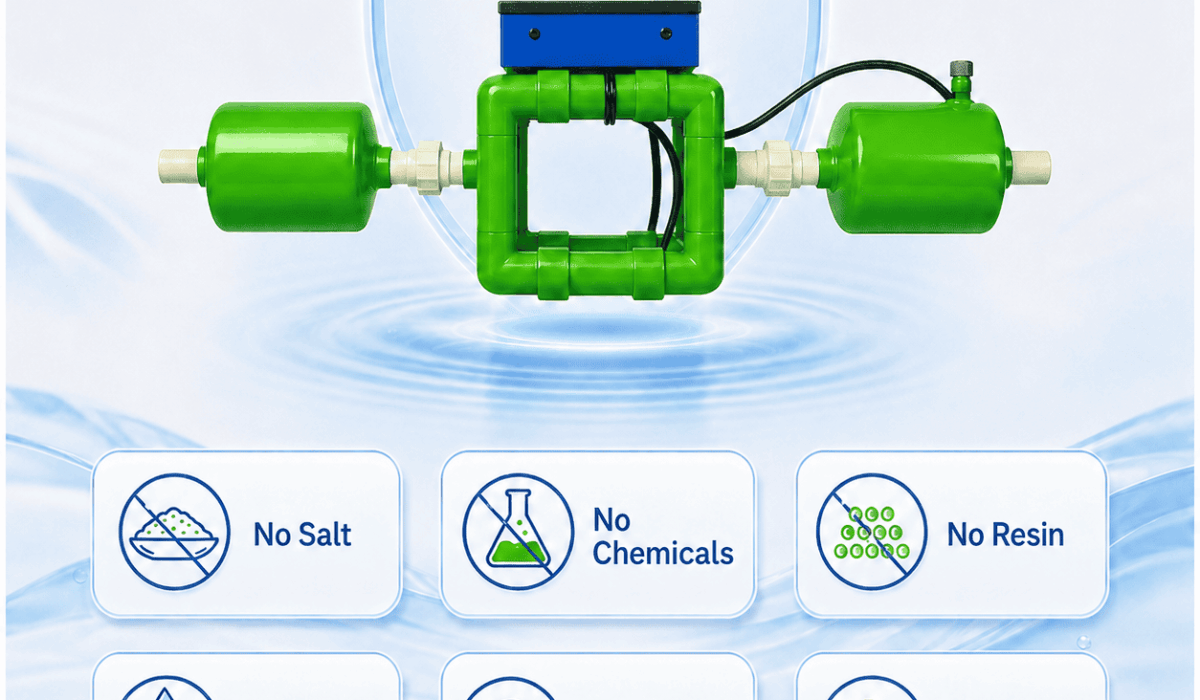
4. No Salt, No Chemicals
Traditional softeners require regular salt replenishment and regeneration.
Water conditioners operate without:
- Salt.
- Chemicals.
- Resin replacement.
- Brine tanks.
This makes them easier to maintain and environmentally friendly.
5. No Water Wastage
Conventional softeners discharge wastewater during regeneration.
Water conditioners:
- Do not require regeneration.
- Produce no brine discharge.
- Conserve water resources.
This makes them suitable for sustainable homes and industries.
6. Maintains Natural Minerals
Calcium and magnesium naturally remain present in conditioned water.
Since no ion exchange takes place:
- Mineral composition remains unchanged.
- Sodium levels are not increased.
- Water retains its natural characteristics.
7. Suitable for Multiple Applications
Water conditioners are used in:
Residential Applications
- Individual homes
- Apartments
- Villas
- Bungalows
- Farmhouses
Commercial Applications
- Hotels
- Hospitals
- Schools
- Offices
- Restaurants
Industrial Applications
- Cooling towers
- Boilers
- Chillers
- Heat exchangers
- Textile industries
Agriculture Applications
- Drip irrigation
- Polyhouses
- Dairy farms
- Horticulture
- Greenhouses
Why Choose Ethix Water Conditioner?
Ethix Water Conditioner is an advanced hard water management system developed for Indian water conditions.
Key Features
✔ Salt-Free Technology
✔ Chemical-Free Operation
✔ Maintenance-Free Design
✔ Low Power Consumption
✔ No Water Wastage
✔ Simple Pipe-to-Pipe Installation
✔ Suitable for Residential, Commercial, Industrial and Agriculture Applications
✔ Helps Reduce Scaling in Water Systems
✔ Long Service Life
✔ Pan-India Support
Is a Water Conditioner Better Than a Water Softener?
The answer depends on your requirement.
If your priority is:
- Reducing scale formation.
- Avoiding salt and chemical consumption.
- Eliminating regeneration cycles.
- Lower maintenance costs.
- Eco-friendly operation.
Then a water conditioner can be an excellent solution.
Conclusion
A water conditioner is a modern hard water treatment system that helps control scale formation by changing the behavior of calcium and magnesium minerals rather than removing them.
It offers several advantages, including:
- Scale protection.
- Reduced maintenance.
- Improved energy efficiency.
- No salt requirement.
- No water wastage.
- Long-term appliance protection.
For homeowners, societies, industries, and agricultural users seeking a smart and sustainable hard water solution, Ethix Water Conditioner provides a reliable alternative to conventional salt-based water softeners.
Frequently Asked Questions
Does a water conditioner remove TDS?
No. Water conditioners do not reduce TDS or remove dissolved minerals.
Does it require salt?
No. Ethix Water Conditioner operates without salt.
Does it waste water?
No. There is no regeneration process or wastewater discharge.
Can it be installed on borewell water?
Yes. It is suitable for hard water and borewell water applications.
Is maintenance required?
Very little maintenance is required compared with conventional water softeners.
Ethix Water Conditioner
Smart Hard Water Solution for Homes, Industries, Commercial Buildings and Agriculture
☎ Toll-Free: 1800-123-6463
🌐 Website: www.ethixwaterconditioner.com