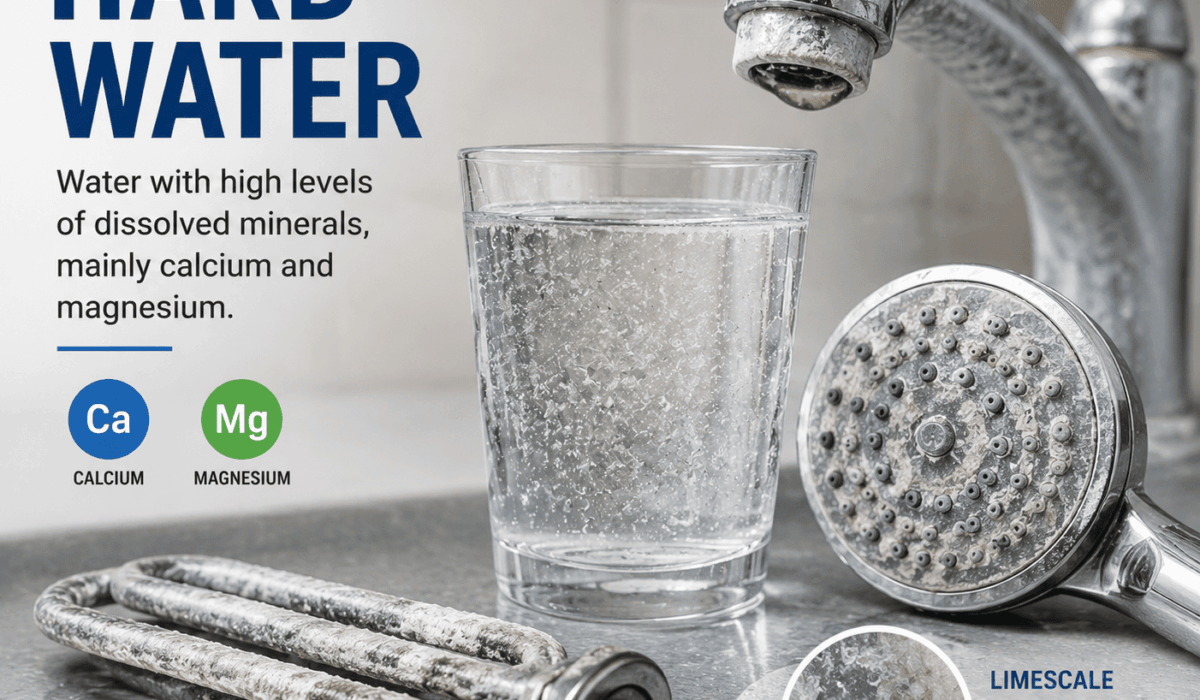
What is hard water? Hard water is water containing relatively high levels of dissolved calcium and magnesium. You may notice it when white deposits appear around a tap, soap does not lather easily or scale collects inside a geyser. It is a common water-quality concern in homes using borewell, tanker or municipal supplies, but the actual hardness depends on the individual water source.
What Causes Hard Water?
As rainwater moves through soil and mineral-rich rocks, it can dissolve calcium and magnesium. Groundwater from borewells is one potential source of hard water, although hardness varies with local geology, the water source and supply conditions. Water can also become hard through other sources, so a water test is more useful than making assumptions about a city or state.
Hardness is not the same as contamination. Calcium and magnesium are naturally occurring minerals. Hard water is not automatically unsafe to drink; drinking-water safety depends on the full water-quality report, including microbiological and chemical parameters.
Temporary and permanent hardness
Temporary hardness is commonly associated with calcium and magnesium bicarbonates. Boiling can precipitate some carbonate hardness in a small amount of water, but it is not a practical whole-house solution. Permanent hardness is associated with other dissolved calcium and magnesium salts; boiling alone does not remove it. For measurable hardness reduction at home or in industry, a properly designed ion-exchange softener may be required.
How Can You Identify Hard Water at Home?
The signs often develop gradually. A single white mark does not prove your water is hard, but several recurring symptoms make a hardness test worthwhile:
White stains and soap scum
Chalky marks on taps, tiles, sinks and shower glass, along with soap residue that is harder to rinse away.
Low soap lather
Soap reacts with calcium and magnesium, so you may notice less lather or need more cleaning product.
Geyser and heater deposits
Mineral scale can accumulate on heating surfaces, especially when hard water is heated repeatedly.
Blocked showerheads
Deposits may build up in small openings. Low pressure can have other causes too, so inspect the plumbing.
Some people also notice rough laundry or changes in how skin and hair feel after washing. These experiences vary and are not, by themselves, a reliable diagnostic test.
Water Hardness Levels: Soft, Moderate, Hard and Very Hard
Water hardness is commonly reported as milligrams per litre of calcium carbonate equivalent (mg/L as CaCO₃). The U.S. Geological Survey's hardness guide uses the following broad categories:
| Hardness category | Total hardness (mg/L as CaCO₃) | Practical meaning |
|---|---|---|
| Soft | 0–60 | Relatively low hardness-related scale potential |
| Moderately hard | 61–120 | Some deposits may appear depending on temperature and use |
| Hard | 121–180 | Soap scum and mineral deposits may become more noticeable |
| Very hard | Above 180 | Greater potential for scaling in susceptible equipment |
For example, a report showing 300 mg/L as CaCO₃ falls in the very-hard category. But hardness alone does not reveal whether a water supply is safe to drink. Check other relevant test parameters separately.
What Are the Effects of Hard Water in Daily Life?
1. Bathroom fittings and white scale
When water evaporates, mineral residue can be left on taps, glass, showerheads and tile surfaces. These deposits may require frequent cleaning. Heavy marks that have already formed may need separate descaling.
2. Geysers, heaters and appliances
Scale can build up on heated surfaces and inside domestic water-using equipment. It may impair heat transfer, cause maintenance issues or shorten service intervals under some operating conditions. Any savings from treatment depend on actual water quality, equipment condition and performance; they should not be assumed for every home.
3. Pipes and water flow
Mineral deposits can narrow pipes and small fittings over time. However, low water pressure may also result from pump, valve or plumbing problems; inspect the system before attributing it entirely to hardness.
4. Soap, detergent and laundry
Hardness minerals can react with soap and affect cleaning performance. Clothes may feel less soft and glassware may show spots, depending on detergent, washing conditions and water chemistry.
5. Skin and hair
Some people report dry-feeling skin, rough hair or more soap residue when washing with hard water. Effects vary by person, product and water composition. A conditioner should not be promoted as a medical treatment or as a guaranteed way to improve skin and hair.
For a more detailed symptom-by-symptom discussion, read the Ethix guide to hard water problems.
How Do You Test Hard Water Correctly?
- Collect a representative sample. Use water from the supply point you want to evaluate, following the laboratory's sampling instructions.
- Request a total-hardness result. Ask for hardness expressed in mg/L as CaCO₃. A hardness test kit can provide an initial estimate; a laboratory report is preferable when specifying treatment equipment.
- Check other parameters when relevant. TDS, pH, iron, turbidity and microbial quality may matter for a particular problem or drinking-water use.
- Match treatment to the actual objective. Do you need a lower measured hardness value, fewer scale deposits, or drinking-water purification? They are different requirements.
A common mistake is using a TDS pen to judge hardness. TDS is not the same as hardness. TDS meters estimate total dissolved substances from conductivity and cannot individually measure calcium and magnesium. See hard water vs TDS, or interpret your measured hardness with the Ethix water hardness calculator.
How Can Hard Water Be Treated?
No single system treats every water problem. Compare technologies by the result you actually need:
| Treatment | Primary purpose | Important distinction |
|---|---|---|
| Ion-exchange water softener | Reduces dissolved calcium and magnesium hardness | Typical salt-based systems need brine regeneration and discharge |
| Salt-free water conditioner | Designed to help reduce scale deposits under suitable conditions | Does not remove hardness minerals or reduce TDS |
| Reverse osmosis (RO) | Reduces many dissolved substances for appropriate water-quality needs | Selection depends on feed-water analysis and intended use |
| Sediment / multimedia filtration | Reduces suspended dirt and turbidity | Does not normally reduce dissolved hardness |
Where Does Ethix Water Conditioner Fit?
Ethix Water Conditioner is presented as a three-stage salt-free conditioning system that combines electrolysis, electronic and electromagnetic processes. Its intended role is to help reduce mineral scale deposits in suitable pipelines, bathroom fittings, geysers and water-using systems, without conventional salt regeneration or resin replacement.
It does not remove dissolved calcium or magnesium, lower laboratory hardness readings, reduce TDS or purify drinking water. Results can vary with water chemistry, flow and installation. Existing severe scale may still require separate cleaning.
For individual houses, villas and bungalows, see the Ethix Delta Series hard water conditioner for home. Installation may involve a pump outlet, overhead tank inlet or another suitable location; correct positioning depends on pipe size, pump HP, storage pattern and the actual plumbing arrangement.
Frequently Asked Questions About Hard Water
What is hard water in simple words?
Hard water contains relatively high levels of dissolved calcium and magnesium. It can leave mineral deposits on taps and in water-heating systems.
Is hard water bad for health?
Hardness alone does not mean water is unsafe to drink. Calcium and magnesium are naturally occurring minerals. Potability depends on other chemical and microbiological test results as well.
Is 300 ppm hardness high?
Yes. A total hardness of 300 mg/L as CaCO₃ is generally classified as very hard. The treatment decision should also consider the intended use and complete water report.
Can a TDS meter tell if water is hard?
No. A TDS meter estimates dissolved solids but cannot separately measure calcium and magnesium hardness. Use a hardness test kit or water laboratory.
Does boiling remove hard water?
Boiling may precipitate some temporary carbonate hardness in a small sample, but it does not remove all hardness and is not a practical treatment for a home's water supply.
Does Ethix Water Conditioner soften water?
Not in the ion-exchange sense. Ethix Water Conditioner is designed to help reduce scale deposits; it does not remove calcium and magnesium or lower TDS.
What is the best hard water solution for a home?
It depends on the goal. A softener can reduce measured hardness, a conditioner may be considered for scale issues, and RO or filtration may be needed for different quality problems. Test the water before choosing.
Not Sure What Your Water Needs?
Share your water source, hardness report, pipe size, pump HP and the problem you are experiencing. The Ethix team can help you evaluate whether a conditioner, softener or another water-treatment solution suits your application.