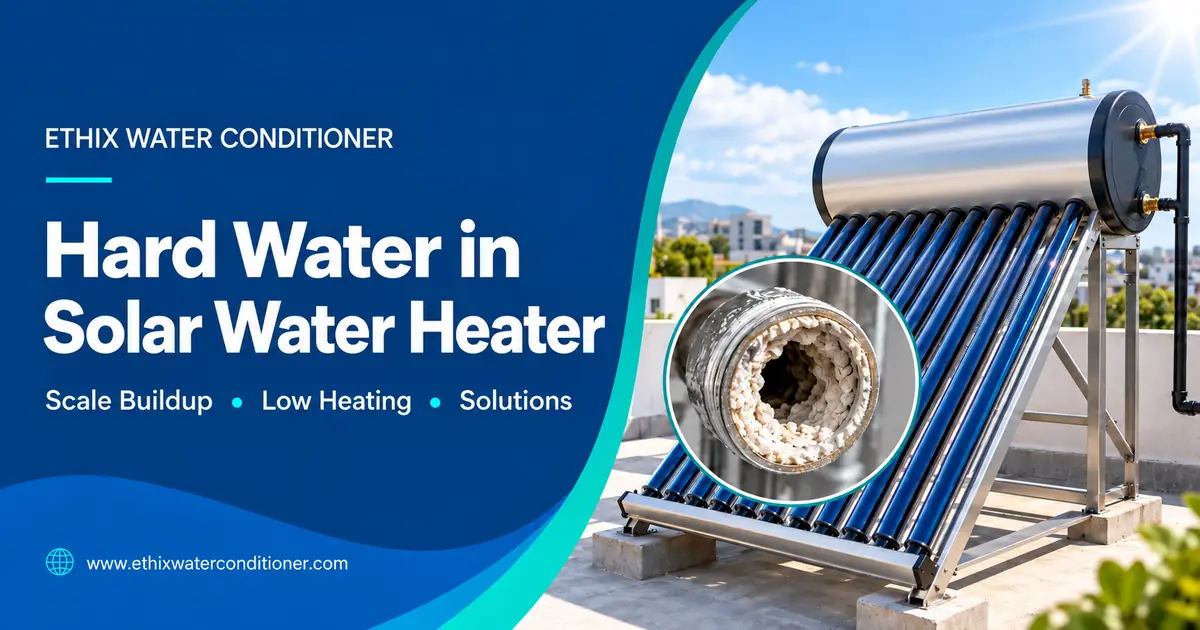
Hard Water in Solar Water Heater: Scale Buildup, Low Heating and Practical Solutions
Is your solar water heater taking longer to provide hot water, showing reduced
hot-water flow or requiring frequent descaling? Hard water may be contributing
to mineral scale inside the solar tank, tubes, heat-transfer surfaces,
pipelines, valves and connected hot-water system.
Hard water contains dissolved minerals, mainly calcium and magnesium.
When mineral-rich water is repeatedly heated, conditions can favour scale
formation on water-contact surfaces. In a solar water-heating system this can
contribute to restricted flow, deposits and additional maintenance.
The correct solution depends on measured hardness, water source,
solar-heater design and the result you require.
- Why hard water causes problems in solar water heaters
- Signs of scale inside a solar hot-water system
- How to test the water and select the correct treatment
- Where Ethix Water Conditioner may fit
1. Why Does Hard Water Affect a Solar Water Heater?
Water hardness is mainly associated with dissolved calcium and magnesium.
Groundwater and borewell water can become hard when water moves through
mineral-rich soil and rock.
Hard water may look perfectly clear. The problem becomes more noticeable
when the same water repeatedly flows through equipment, evaporates or is heated.
Mineral deposits can gradually develop on water-contact surfaces.
A solar water heater is particularly relevant because its purpose is to heat
water every day. Depending on the system design, heated hard water can come in
contact with a storage tank, collector tubes, coils, valves, fittings and
hot-water pipelines.
Calcium and magnesium are present in the source water.
Repeated heating can encourage scale-forming conditions.
Scale can gradually collect on internal water-contact surfaces.
Hardness Levels
Water hardness is commonly reported as milligrams per litre
(mg/L) as calcium carbonate, written as CaCO₃.
| Hardness | Approximate Level | What It Means |
|---|---|---|
| Soft | 0–60 mg/L | Lower hardness |
| Moderately Hard | 61–120 mg/L | Moderate mineral hardness |
| Hard | 121–180 mg/L | Scale-related problems may become more noticeable |
| Very Hard | Above 180 mg/L | Higher potential for hardness-related problems |
These commonly used classifications are based on total hardness as CaCO₃.
Actual treatment selection should also consider the complete water report,
operating temperature, water consumption and equipment design.
2. Signs of Hard Water Scale in a Solar Water Heater
One symptom alone does not prove that hardness is the cause.
Look for a pattern across the solar system and the rest of the property.
Deposits inside valves, fittings or pipelines may gradually restrict flow.
Repeated mineral deposits can increase cleaning and servicing requirements.
Similar deposits may also appear on nearby taps, showers and bathroom fittings.
Deposits on heat-transfer surfaces may contribute to reduced heat-transfer performance.
Aerators, valves and narrow passages can accumulate mineral deposits.
Geysers, showers and pipelines showing similar scale indicate a wider hardness issue.
Where Can Scale Form?
The exact location depends on the solar water heater design. Potential
scale-prone areas may include:
- Solar hot-water storage tanks
- Evacuated tubes in suitable direct-water systems
- Heat-transfer coils or heat exchangers
- Hot-water pipelines
- Valves and fittings
- Tank inlet and outlet connections
- Mixing valves
- Bathroom showerheads and tap aerators
Reduced heating or low water flow does not always mean hard water.
Solar collector condition, insulation, plumbing layout, air locks,
valves, circulation, sunlight availability and equipment faults can
produce similar symptoms. Proper diagnosis is important.
Hard Water vs TDS
Do not select a solar water-heater treatment system using only a TDS meter.
TDS and hardness are different measurements.
A TDS meter estimates the total amount of dissolved ionic material in water.
It does not separately tell you how much calcium and magnesium hardness is present.
If scaling is the concern, measure total hardness separately.
Read our
Hard Water vs TDS guide
for a detailed explanation.
3. How to Test and Treat Hard Water for a Solar Water Heater
Step 1: Test Total Hardness
Use a suitable hardness test kit or a laboratory water analysis.
Hardness should normally be reported as mg/L as CaCO₃.
If you have not tested the water yet, see our
guide to testing water hardness at home
.
Step 2: Check the Complete Water Source
For a better treatment decision, note:
- Borewell, tanker, municipal or mixed water source
- Total hardness
- TDS
- pH
- Iron if staining is present
- Alkalinity where relevant
- Daily hot-water consumption
- Solar tank capacity
- Pipe size and approximate flow
- Existing scale condition
Step 3: Choose Treatment According to the Required Result
| Requirement | Typical Treatment Direction | Important Point |
|---|---|---|
| Actual reduction in calcium and magnesium hardness | Ion-exchange water softener | Requires suitable resin, salt regeneration and maintenance |
| Scale-management without salt regeneration | Suitable water conditioner | Hardness minerals remain in the water |
| Sand, rust or suspended particles | Sediment or media filtration | Does not remove dissolved hardness by itself |
| Drinking-water TDS reduction | Suitable RO system after water testing | Different objective from whole-line scale management |
| Heavy existing scale inside equipment | Manufacturer-approved servicing/descaling may be required | Follow the solar equipment manufacturer’s instructions |
Traditional Water Softener
A cation-exchange water softener is designed to remove hardness-causing
calcium and magnesium ions through ion exchange. This is appropriate when
the required outcome is an actual reduction in measurable hardness.
Such systems normally require resin regeneration using salt and require
suitable drainage, sizing and ongoing operation.
Salt-Free Scale Management
If the primary objective is helping manage scale formation while avoiding
softener-style salt regeneration, a suitable water-conditioning system may
be considered.
However, a water conditioner should not be represented as an RO purifier
or an ion-exchange softener if it does not actually remove dissolved
calcium and magnesium.
4. Ethix Water Conditioner for Solar Water Heater Scale Management
Ethix Water Conditioner is designed as a salt-free water-conditioning
solution for scale-related hard-water applications.
Depending on the site’s plumbing design, it may be planned on a suitable
source-water line before water reaches the solar water heater and connected
hot-water distribution system.
Why Customers Consider Ethix
No softener-style salt regeneration is required.
The conditioner does not use an ion-exchange resin bed.
No softener-style brine wastewater is produced.
Can be assessed for a suitable main water line based on the site.
Intended for scale-related hard-water applications.
Selection considers pipe, pump, source and water-system details.
Ethix Water Conditioner does not reduce TDS like RO and is not an
ion-exchange water softener. It should not be expected to produce a lower
laboratory hardness reading by removing calcium and magnesium.
Its intended role is salt-free hard-water scale management.
Information Required Before Selecting an Ethix Model
- City and state
- Water source
- Total hardness and TDS report if available
- Solar water-heater capacity
- Pipe size
- Pump HP or operating flow
- Daily water consumption
- Underground and overhead tank details
- Existing scale problem
- Photographs or video of the installation area
You can also explore our
hard water solution guide for India
to understand the difference between hardness reduction,
TDS reduction and scale management.
Frequently Asked Questions
Can hard water damage a solar water heater?
Hardness minerals can contribute to scale deposits on water-contact
surfaces in solar water-heating systems. The degree of scaling depends
on the water chemistry, temperature, equipment design and operating conditions.
Why is white scale forming in my solar hot-water system?
White deposits are commonly associated with mineral-rich water.
Confirm the cause with a proper hardness test rather than relying only
on visible deposits or a TDS reading.
Does a TDS meter measure water hardness?
No. A TDS meter estimates total dissolved ionic material.
Use a total-hardness test when calcium and magnesium hardness is the concern.
Should I use a water softener for a solar water heater?
An ion-exchange softener can be appropriate when actual calcium and
magnesium hardness reduction is required. Final selection should depend
on the water analysis and equipment requirements.
Can Ethix Water Conditioner reduce TDS?
No. Ethix is not an RO purifier and does not reduce TDS.
Will Ethix reduce the laboratory hardness value?
Ethix is designed for salt-free scale management rather than ion-exchange
hardness removal. Calcium and magnesium remain present in the treated water.
Where should a water conditioner be installed for a solar heater?
The correct installation point depends on the water source, tank arrangement,
pipe size, pump, flow and plumbing layout. Site details should be reviewed
before selecting the final location.
Facing Solar Water Heater Scaling?
Share your water source, hardness report, solar tank capacity,
pipe size, pump details and installation photos with the Ethix team
for a suitable technical recommendation.
Toll-Free: 1800-123-6463
References & Technical Basis
Water-hardness definitions and hardness-level classification:
U.S. Geological Survey, Water Science School – Hardness of Water.
Ion-exchange water-softener operating principles:
U.S. Environmental Protection Agency WaterSense –
Cation Exchange Water Softeners.
Technical Note:
Treatment selection should always be based on actual water analysis,
equipment requirements and site conditions. Solar water-heater servicing
and chemical descaling should follow the equipment manufacturer’s guidance.