
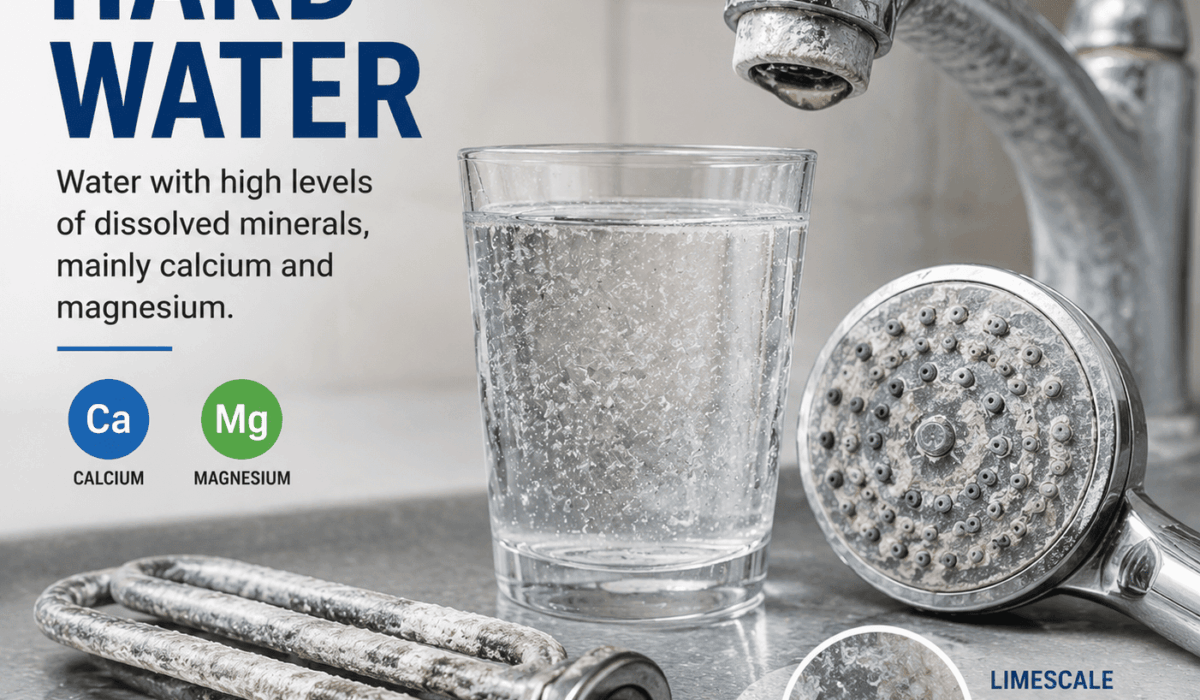
A low or high TDS number does not automatically tell you whether your water is hard. Learn the difference before choosing a water softener, water conditioner, RO system or filter for your home.
A TDS meter measures the total amount of dissolved material in water. It does not identify how much calcium and magnesium are present, so it cannot confirm water hardness. For a correct hard-water solution, use a proper water-quality report and check hardness separately.
What Is Hard Water?
Hard water contains dissolved minerals, mainly calcium and magnesium. These minerals can leave white marks on taps, tiles, shower glass, buckets and utensils after water dries. Inside a plumbing system, they can form scale deposits in pipelines, geysers, showerheads, washing machines and water-heating equipment.
Common signs of hard water include white stains on bathroom fittings, blocked shower holes, poor soap foam, rough clothes after washing, scale inside geysers and repeated cleaning requirements. A water hardness test is the most reliable way to confirm whether calcium and magnesium hardness are causing these issues.
Read our detailed guide: What Is Hard Water?
What Is TDS in Water?
TDS means Total Dissolved Solids. It is a combined reading of dissolved substances in water. Depending on the source, TDS may include calcium, magnesium, sodium, chloride, sulphates, bicarbonates and other dissolved minerals.
A TDS meter gives a general conductivity-based reading. It is useful as a quick indication of dissolved content, but it does not identify each mineral separately. Therefore, a TDS value cannot tell you whether the water has high calcium and magnesium hardness.
Hard Water vs TDS: The Main Difference
| Point | Water Hardness | TDS |
|---|---|---|
| What it measures | Mainly calcium and magnesium minerals that cause hardness. | Total dissolved substances present in water. |
| Typical unit | mg/L or ppm as CaCO₃. | ppm or mg/L. |
| Can a basic meter measure it? | No. A proper hardness test is required. | Yes. A TDS meter can provide an approximate TDS reading. |
| Main concern | Scale formation, soap scum, blocked fittings and geyser deposits. | Overall dissolved content in water. |
| Best treatment decision | Depends on the hardness value, usage and application. | Depends on water source, drinking-water need and complete test report. |
For example, two water samples may show similar TDS values but have very different hardness levels. One sample may contain higher calcium and magnesium, while another may contain other dissolved salts. This is why selecting a system only from a TDS meter reading can lead to the wrong treatment choice.
Why a TDS Meter Cannot Measure Water Hardness
A TDS meter cannot distinguish calcium and magnesium from other dissolved minerals. It only gives a combined estimate of conductivity. Water with moderate TDS may still create serious white stains and scale if calcium and magnesium are high.
Before selecting a water-treatment system, ask for a water test that includes hardness, TDS, pH, iron, turbidity and any visible issue such as smell, colour, mud or scale deposits. This gives a clearer picture of the actual water problem.
Choose the Right Solution for Your Water Problem
| Your Requirement | Suitable Treatment Direction |
|---|---|
| Actual reduction of calcium and magnesium hardness is required. | A resin-based ion-exchange water softener may be suitable after reviewing the water report and daily consumption. |
| Scale management is needed in pipelines, taps, geysers and utility water lines. | A salt-free water conditioner or scale-management system may be suitable. |
| Drinking-water TDS reduction is required. | An RO water purifier should be selected based on complete water quality and drinking-water requirements. |
| Mud, sand or suspended particles are present. | A sediment filter, sand filter or suitable pre-filtration system may be required. |
| Iron staining, odour or yellow water is present. | An iron-removal or specialised water-treatment system may be required. |
For more information, read: Does Hard Water Damage RO Membrane?
Where Does Ethix Water Conditioner Fit?
Ethix Water Conditioner is designed for salt-free hard-water scale management in suitable plumbing and utility-water applications. It helps reduce scale-related problems in pipelines, taps, showerheads, geysers, bathroom fittings and water-using equipment.
It works without salt filling, chemical dosing, resin replacement or regular backwashing. Ethix Water Conditioner is not an RO purifier and should not be used to claim TDS reduction. Where a customer needs a specific reduction in measured hardness, an ion-exchange water softener may be the more suitable option.
Ethix can be selected for homes, flats, bungalows, residential societies, hotels, hospitals, agriculture, commercial properties and industrial applications after checking the pipe size, water flow, water source, motor HP and visible scale issue.
Explore: Water Conditioner for Home | Residential Hard Water Solution | Water Softener vs Water Conditioner
Frequently Asked Questions
Can a TDS meter check water hardness?
No. A TDS meter gives an overall dissolved-solids reading. It cannot separately measure calcium and magnesium hardness. A dedicated water hardness test is required.
Can water have high TDS but low hardness?
Yes. TDS can include many dissolved substances other than calcium and magnesium. A complete water test is needed to understand the cause of a high TDS reading.
Does Ethix Water Conditioner reduce TDS?
No. Ethix Water Conditioner is not an RO system and does not claim TDS reduction. It is intended for salt-free scale-management applications.
Which details are required to select an Ethix model?
Share your water source, pipeline size in inches, motor HP, water flow, daily water consumption, water test report and visible hard-water problem for a suitable recommendation.
Get the Right Hard Water Solution for Your Property
Share your water source, pipe size, motor HP, daily water requirement and visible scale issue with Ethix for a suitable recommendation.
Call Toll Free: 1800-123-6463 Send EnquiryTechnical reference: Water hardness is mainly associated with calcium and magnesium. For independent educational information, refer to the USGS guide on water hardness and the CDC guide to home water treatment.
10 thoughts on “Hard Water vs TDS: Can a TDS Meter Check Water Hardness?”