
Commercial Water Guide
Hard Water Problems in Hotels: Why They Affect Operations
Hotels use water continuously across guest rooms, kitchens, laundry, hot-water systems, housekeeping and landscaping. When calcium and magnesium levels are high, recurring scale and soap residue may affect appearance, cleaning effort, linen quality, water flow and connected equipment.
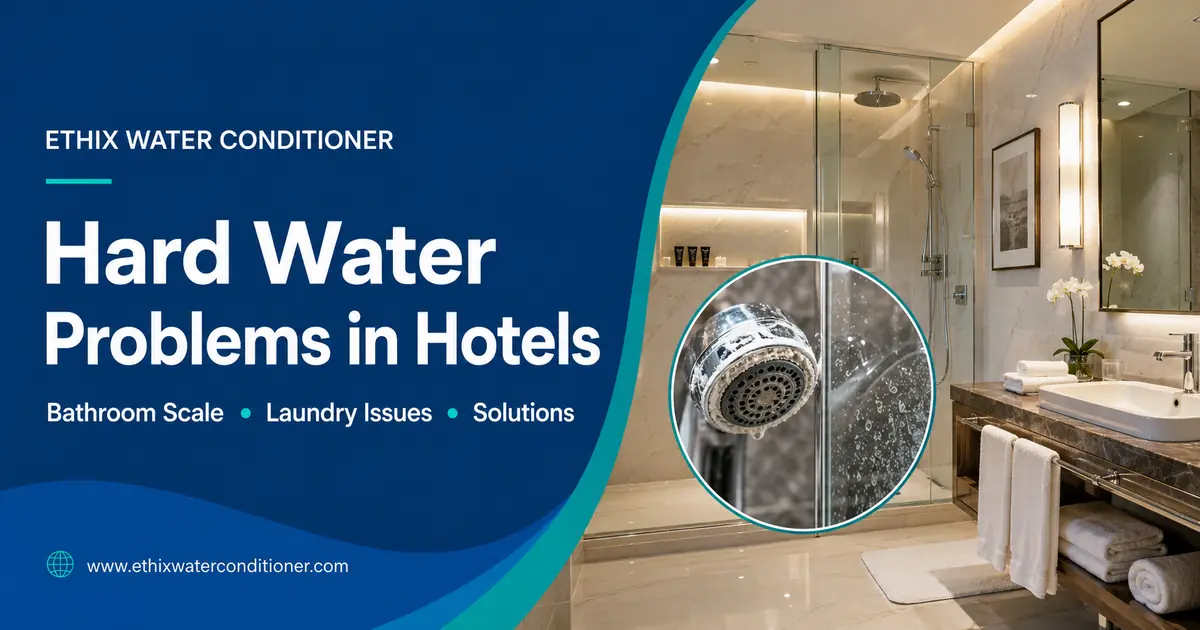
Hard water can become both a guest-experience and maintenance issue. Common signs include white bathroom deposits, blocked showerheads, poor soap lather, dull linen and scale in hot-water equipment. Test each water source and map the problem before selecting treatment.
1. Where Hard Water Affects Hotel Operations
| Area | Possible hard-water effect | What staff may observe |
|---|---|---|
| Guest bathrooms | Scale and soap residue on fixtures | White spots, dull glass, blocked shower spray |
| Laundry | Mineral-detergent residue | Stiff towels, dull linen or higher product demand |
| Geysers / calorifiers | Scale on heating and hot-water surfaces | Slow recovery, noise or frequent descaling |
| Kitchen / dishwashing | Spots and deposits on equipment | Cloudy glassware, marks on utensils or spray blockage |
| Taps and valves | Deposits in aerators and moving parts | Reduced flow, stiffness or repeated replacement |
| Housekeeping | Recurring mineral residue | More scrubbing and faster return of white deposits |
Why hot-water areas show scale first
Heating and evaporation can encourage minerals to leave solution and attach to surfaces. Therefore, hot-water lines, heaters, kettles, coffee equipment and dishwashers may show deposits sooner than cold-water outlets.
Do not diagnose every mark as hardness scale. Silica, iron, cleaning chemicals, corrosion, detergent residue and poor rinsing can produce similar symptoms. Deposit and water testing prevent the wrong investment.
2. How to Assess a Hotel Hard-Water Problem
Test all important sources
Hotels may receive municipal, borewell and tanker water with different chemistry. Collect representative samples before and after existing treatment. Useful parameters include total hardness, calcium, magnesium, alkalinity, pH, TDS/conductivity, iron, manganese, suspended solids and microbiological quality where applicable.
TDS is not the same as hardness. A TDS meter cannot separately measure calcium and magnesium or identify the deposit.
Map complaints and maintenance records
- Record affected rooms, floors, wings and water sources.
- Compare hot and cold outlets and peak-occupancy periods.
- Track showerhead, aerator, heater and valve cleaning frequency.
- Review laundry chemical dosage, rinse quality and linen replacement.
- Inspect storage tanks, recirculation loops and dead legs.
- Measure pipe size, flow and pressure at the proposed treatment point.
- Room count, occupancy and daily water consumption
- Source-wise water reports and seasonal variation
- Plumbing layout, tank capacity and recirculation design
- Pipe size, pump capacity and peak flow
- Existing filters, softener, RO or chemical treatment
- Priority: physical softening, scale management, drinking water or suspended-solids removal
3. Hotel Water-Treatment and Maintenance Options
| Requirement | Typical direction | Important limitation |
|---|---|---|
| Physically reduce calcium and magnesium | Ion-exchange water softener | Requires salt, regeneration, drainage, resin care and monitoring |
| Remove sand, rust or suspended solids | Media, bag or cartridge filtration | Does not remove dissolved hardness by itself |
| Reduce dissolved salts for drinking or process use | Suitably designed RO system | Needs pretreatment, maintenance and reject-water planning |
| Manage scale behaviour without salt | Salt-free water conditioner | Does not reduce laboratory hardness or TDS readings |
| Control microorganisms | Approved disinfection / UV where appropriate | Does not remove hardness scale |
Operational practices remain essential
- Standardise housekeeping chemicals and dilution.
- Clean showerheads and aerators on a documented schedule.
- Follow laundry supplier guidance for detergent and hardness.
- Maintain safe hot-water temperatures and hygiene controls.
- Inspect heaters and recirculation systems through authorised service.
- Trend water quality, maintenance hours and guest complaints.
4. Where Ethix Water Conditioner May Fit
Ethix Water Conditioner is designed as a salt-free scale-management option for commercial plumbing and connected equipment. It may suit hotels seeking a chemical-free, media-free approach without salt regeneration where recurring mineral scale is the main verified concern.
Ethix does not remove calcium and magnesium, does not reduce TDS and is not a drinking-water purifier. It does not replace filtration, disinfection, hygiene management or equipment maintenance. Performance should be evaluated through agreed operational evidence such as deposit behaviour, cleaning frequency, fixture flow and equipment condition.
Correct model selection depends on pipe size, pump capacity, peak flow, source water, daily consumption, storage and installation point. Share your hotel details with Ethix for technical review.
Frequently Asked Questions
How does hard water affect hotel guests?
Guests may notice white bathroom deposits, low soap lather, reduced shower spray or rough-feeling linen. These signs should be confirmed with water and system checks.
Can hard water make towels stiff?
Mineral and detergent residue may contribute, but product dosage, rinsing, drying and fabric-softener buildup also matter.
Does a sediment filter solve hotel hard water?
No. It removes suspended particles but normally does not remove dissolved calcium and magnesium.
Should treatment be placed before or after the storage tank?
The correct point depends on source blending, tank retention, refill frequency, pump arrangement and which outlets require treatment. A site survey is needed.
Can one system treat guest rooms, laundry and kitchen?
Sometimes a main-line system is practical, but each area may need a different water quality. Laundry, drinking and process requirements should be assessed separately.
Does Ethix reduce hardness or TDS?
No. Ethix is intended to help manage scale behaviour; it does not claim to reduce laboratory hardness or TDS readings.