
Agriculture Water Guide
Hard Water in Drip Irrigation: Why Emitters Get Blocked
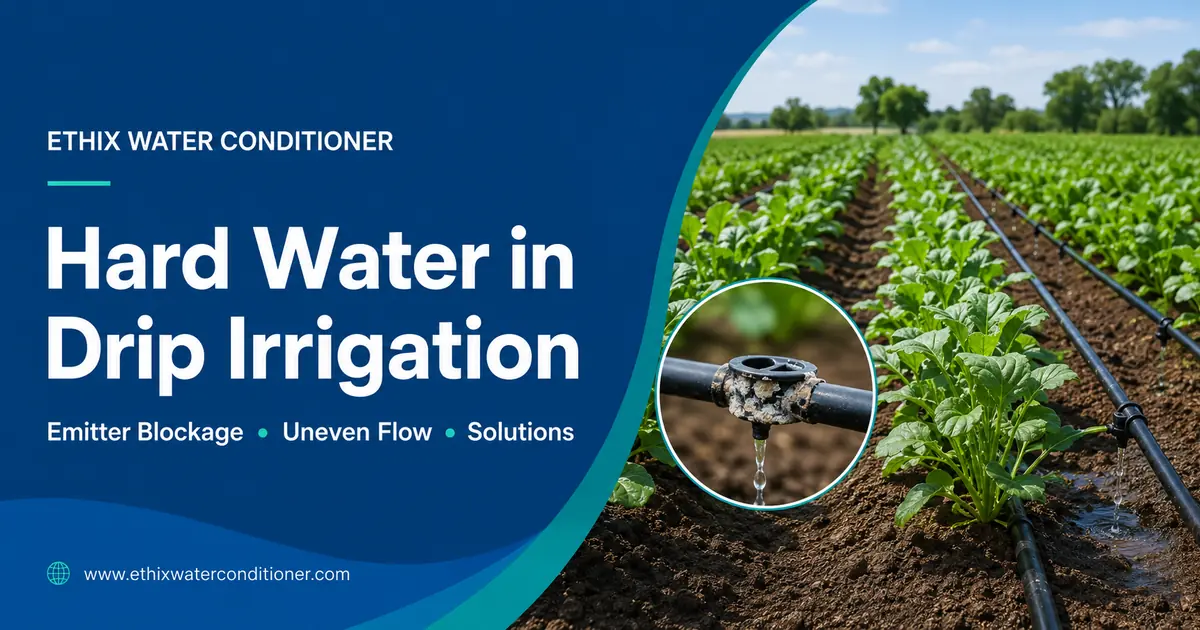
Drip irrigation depends on small water passages and uniform pressure. When borewell or source water contains hardness minerals, chemical conditions can promote calcium carbonate or other mineral deposits inside emitters, laterals, filters and valves. This may reduce discharge and create uneven irrigation across the field.
Hard water can contribute to chemical clogging, but it is not the only cause of dripper blockage. Sand, silt, algae, bacteria, iron and fertiliser reactions can produce similar symptoms. Test the source water and deposits before selecting filtration, chemical maintenance or scale management.
1. Why Drip Emitters and Irrigation Lines Become Blocked
| Type | Common sources | Typical clues |
|---|---|---|
| Physical | Sand, silt, clay, organic debris | Grit in filters or emitters; rapid blockage after pumping |
| Chemical | Calcium carbonate, iron, manganese or fertiliser precipitation | Hard crystalline deposits or coloured mineral residue |
| Biological | Algae, bacteria, slime and roots | Soft, sticky or fibrous deposits with odour or growth |
How hardness-related scale develops
Scale risk depends on more than the hardness number. Bicarbonate alkalinity, pH, temperature, concentration, aeration and fertiliser chemistry influence whether minerals stay dissolved or precipitate. Long laterals, pressure variation and low-velocity zones can make deposits more visible at specific locations.
- Emitter discharge gradually falls in affected rows.
- End-of-line flow becomes weaker than inlet-side flow.
- White or cream-coloured deposits appear inside emitters or pipes.
- Filters and fittings require increasingly frequent cleaning.
- Wet areas around plants become uneven despite adequate pump operation.
Uneven crop growth does not prove a water-conditioning issue. Hydraulic design, pressure, root health, soil variability, pests, nutrition and emitter spacing must also be checked.
2. How to Diagnose Hard-Water Blockage Correctly
Start with a complete water report
Test the raw water before fertiliser injection. Useful parameters include total hardness, calcium, magnesium, alkalinity or bicarbonate, pH, EC/TDS, iron, manganese, suspended solids and microbiological indicators where relevant. A TDS meter alone cannot identify hardness or predict the exact deposit.
Inspect the system in a fixed pattern
- Measure pump pressure and flow at the system inlet.
- Check pressure before and after the filtration unit.
- Compare emitter discharge near the start, middle and end of laterals.
- Open representative blocked emitters and examine the deposit.
- Record whether blockage increases after fertigation or during hot periods.
- Send water and deposit samples for professional analysis when the cause is unclear.
- Crop, field area and irrigation schedule
- Water source and complete laboratory report
- Pump capacity, main pipe size and operating flow
- Filter type, micron rating and backwash practice
- Emitter type, discharge, lateral length and pressure
- Fertilisers and chemicals injected into the system
3. How to Manage Dripper Blockage and Uneven Flow
Match the solution to the blockage type
| Problem | Typical direction | Important point |
|---|---|---|
| Sand, silt or suspended solids | Hydrocyclone, screen, disc or media filtration | Size for actual flow and particle load |
| Calcium carbonate precipitation | Water-chemistry control, approved acidification or scale-management approach | Requires professional dosing and compatibility checks |
| Iron or manganese deposits | Oxidation and suitable filtration | Water analysis determines the process |
| Algae or biological slime | Source control and approved disinfection program | Follow agricultural and equipment guidance |
| Hydraulic non-uniformity | Pressure correction, zoning or design changes | Water treatment alone will not repair poor hydraulics |
Preventive operating practices
- Maintain filters and use differential pressure as a cleaning indicator.
- Flush mains, submains and laterals on a documented schedule.
- Do not mix fertilisers without checking compatibility and water chemistry.
- Keep chemical dosing calibrated and handled by trained personnel.
- Monitor a fixed sample of emitters and record discharge over time.
- Repair leaks, damaged laterals and pressure-regulation faults promptly.
4. Where Ethix Water Conditioner May Fit in Agriculture
Ethix Water Conditioner is designed as a salt-free scale-management option for water lines and connected equipment. In agricultural applications, it may be considered when mineral scale is a verified contributor to blockage and the farm seeks a chemical-free, media-free approach without salt regeneration.
Ethix does not remove calcium and magnesium, does not reduce TDS and does not replace correctly selected filtration, hydraulic design, fertigation management or biological control. Results should be evaluated through emitter discharge, pressure, flushing frequency and deposit behaviour—not by expecting lower laboratory hardness or TDS readings.
Correct sizing depends on the report, main pipe size, pump capacity, operating flow, irrigation layout and installation point. Explore the Ethix agriculture solution or share your farm details for assessment.
Frequently Asked Questions
Can hard water block drip emitters?
Yes, mineral precipitation can contribute to chemical blockage, especially in narrow passages. Confirm the deposit because sand, algae, iron and fertiliser reactions can look similar.
Is high TDS the same as hard water?
No. TDS represents total dissolved ions, while hardness mainly relates to calcium and magnesium. Test both when making a treatment decision.
Will a filter remove hardness scale?
A filter removes suspended particles but normally does not remove dissolved hardness. It remains essential for physical clogging control.
Can acid clean blocked drip lines?
Acid treatment may be used in specific systems under professional guidance. The dose depends on water chemistry, deposit type and material compatibility. Unsafe dosing can damage crops, equipment or people.
Why are only the last emitters weak?
Possible causes include pressure loss, excessive lateral length, poor flushing, sediment movement or deposits. Check hydraulics before assigning the problem only to hardness.
Does Ethix reduce hardness or TDS?
No. Ethix is intended to help manage scale behaviour; it does not claim to reduce laboratory hardness or TDS readings.