
Industrial Water Guide
Hard Water in Cooling Towers: Why Scale Builds Up
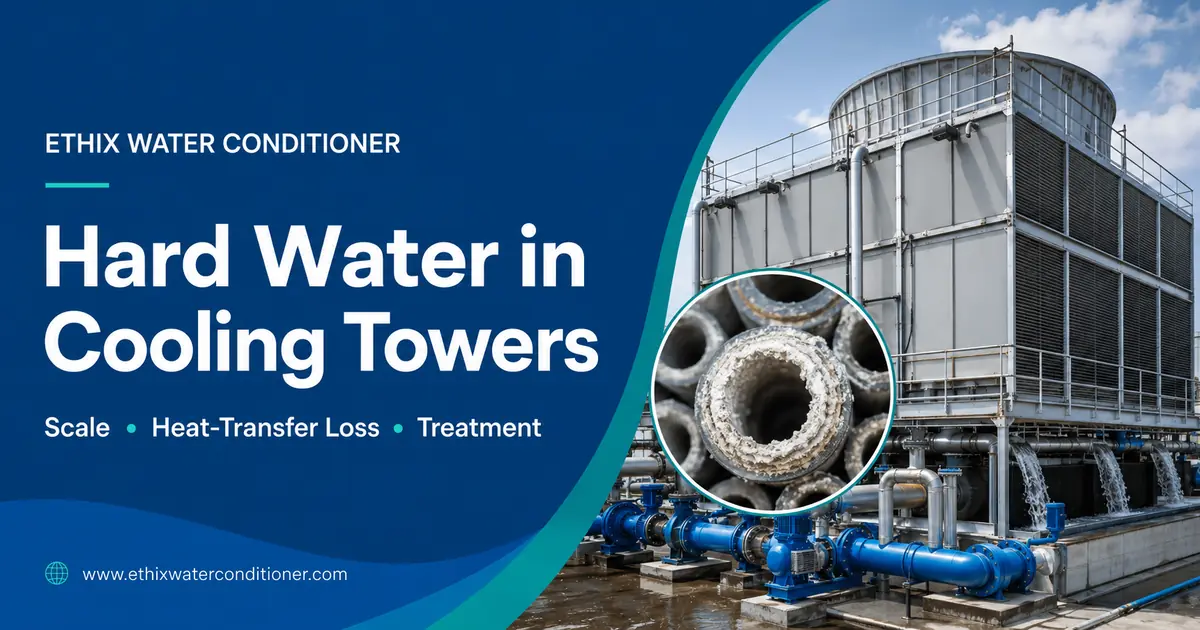
A cooling tower rejects heat by evaporating part of the circulating water. The minerals remain behind, so calcium, magnesium, alkalinity, silica and other dissolved solids become more concentrated. If operating conditions cross their solubility limits, deposits may form on fill, nozzles, piping, basins, condensers and heat exchangers.
Cooling-tower scale is a water-chemistry and operating-control problem—not simply a high-TDS problem. Treatment must balance scale, corrosion, microbiological control and water use. Makeup-water analysis, cycles of concentration, blowdown control and deposit identification are essential before changing the program.
1. How Hard Water Creates Cooling-Tower Scale
Cycles of concentration multiply the risk
Cycles of concentration compare a dissolved constituent in circulating water with the same constituent in makeup water. As cycles rise, water use may improve, but the concentration of scale-forming and corrosive species also rises. The safe operating window depends on the complete chemistry and system conditions.
| Location | Possible deposit effect | Operational clue |
|---|---|---|
| Heat exchanger / condenser | Insulating layer on heat-transfer surface | Higher approach temperature or reduced thermal performance |
| Cooling-tower fill | Restricted air-water contact and added weight | Uneven wetting, reduced cooling or damaged fill |
| Spray nozzles | Reduced or distorted water distribution | Dry zones or irregular spray pattern |
| Pipes and valves | Reduced cross-section or movement | Pressure change, low flow or maintenance difficulty |
| Basin and strainers | Settled solids and loose deposits | Frequent cleaning or recirculation of debris |
Not every deposit is calcium scale
Deposits can contain corrosion products, suspended solids, silica, microbiological material or combinations of these. A white appearance alone does not identify the chemistry. Deposit analysis is especially valuable when the existing treatment program is not performing as expected.
Safety: Cooling towers can present microbiological and aerosol risks, including Legionella. Scale-control equipment does not replace an appropriate water-management plan, biocide program, cleaning, disinfection or regulatory compliance.
2. How to Diagnose and Monitor Cooling-Tower Scale Risk
Test makeup and circulating water separately
Useful parameters typically include pH, conductivity/TDS, total and calcium hardness, alkalinity, chloride, sulphate, silica, iron, suspended solids and microbiological indicators. Requirements vary by metallurgy, process and treatment program.
A TDS meter alone cannot determine hardness or identify which mineral will precipitate. Trend results over time rather than relying on a single sample.
Combine chemistry with operating data
- Makeup, blowdown and recirculation flow
- Conductivity-controller setpoint and calibration
- Cycles of concentration based on a suitable conservative ion
- Inhibitor and biocide residuals under the approved program
- Temperatures, approach, pressure drop and heat-exchanger performance
- Inspection photographs, deposit location and cleaning frequency
- Makeup-water laboratory report and seasonal variation
- Tower capacity, recirculation rate and makeup flow
- Operating hours, heat load and target cycles
- System metallurgy and process sensitivity
- Existing filtration, chemical dosing and blowdown controls
- Current scale, corrosion and microbiological history
3. Cooling-Tower Scale-Control and Treatment Options
| Measure | Main purpose | Important limitation |
|---|---|---|
| Conductivity-controlled blowdown | Limits concentration of dissolved solids | Needs calibrated control and uses water |
| Chemical inhibitors / pH control | Manage scale and corrosion within a designed program | Requires dosing, monitoring, safety and discharge compliance |
| Side-stream filtration | Removes suspended solids from circulating water | Does not remove dissolved hardness by itself |
| Makeup-water softening | Physically reduces calcium and magnesium | Requires salt, regeneration, drainage and corrosion review |
| RO or demineralisation | Reduces dissolved salts for demanding applications | Higher capital, pretreatment, reject and operating requirements |
| Salt-free conditioning | Intended to influence scale behaviour without salt | Does not reduce laboratory hardness or TDS and must be validated on site |
Good operation supports every technology
- Keep conductivity probes, flow meters and dosing equipment calibrated.
- Inspect spray nozzles, fill, strainers, basins and heat exchangers routinely.
- Control suspended solids with appropriate filtration and housekeeping.
- Maintain documented microbiological monitoring and response procedures.
- Review cycles and treatment whenever makeup-water quality or heat load changes.
4. Where Ethix Water Conditioner May Fit
Ethix Water Conditioner is designed as a salt-free scale-management option for industrial water lines and connected equipment. In a cooling-tower system, it may be considered as one component of an engineered program after water chemistry, flow, metallurgy, heat load and existing treatment have been reviewed.
Ethix does not remove calcium and magnesium, does not reduce TDS, and does not replace filtration, blowdown, corrosion inhibitors, biocides, cleaning or microbiological controls. Performance should be evaluated through agreed operating evidence such as deposit behaviour, approach temperature, pressure drop, cleaning frequency and water-use data.
Correct sizing requires pipe size, recirculation and makeup flow, pump data, operating hours, water report and installation point. Share your cooling-tower data with Ethix for technical review.
Frequently Asked Questions
Why does scale increase at higher cycles of concentration?
Evaporation leaves minerals behind. As circulating-water concentration rises, some salts may exceed their solubility under the system’s pH and temperature conditions.
Is conductivity the same as hardness?
No. Conductivity reflects the water’s overall ionic content; it does not separately measure calcium and magnesium hardness.
Can side-stream filtration remove hardness?
It removes suspended solids from a portion of the recirculating flow but normally does not remove dissolved hardness.
Can cooling towers operate without chemicals?
That decision requires site-specific engineering and microbiological risk assessment. Scale control alone never replaces corrosion and biological control.
How should scale-control performance be verified?
Agree on baseline and post-installation evidence such as chemistry trends, deposit inspection, approach temperature, pressure drop, cleaning records, makeup and blowdown volumes.
Does Ethix reduce hardness or TDS?
No. Ethix is intended to help manage scale behaviour; it does not claim to reduce laboratory hardness or TDS readings.


One thought on “Hard Water in Cooling Towers”