Hard Water Solution Guide
Maintenance-Free Water Softener for Hard Water: What Does It Really Mean?
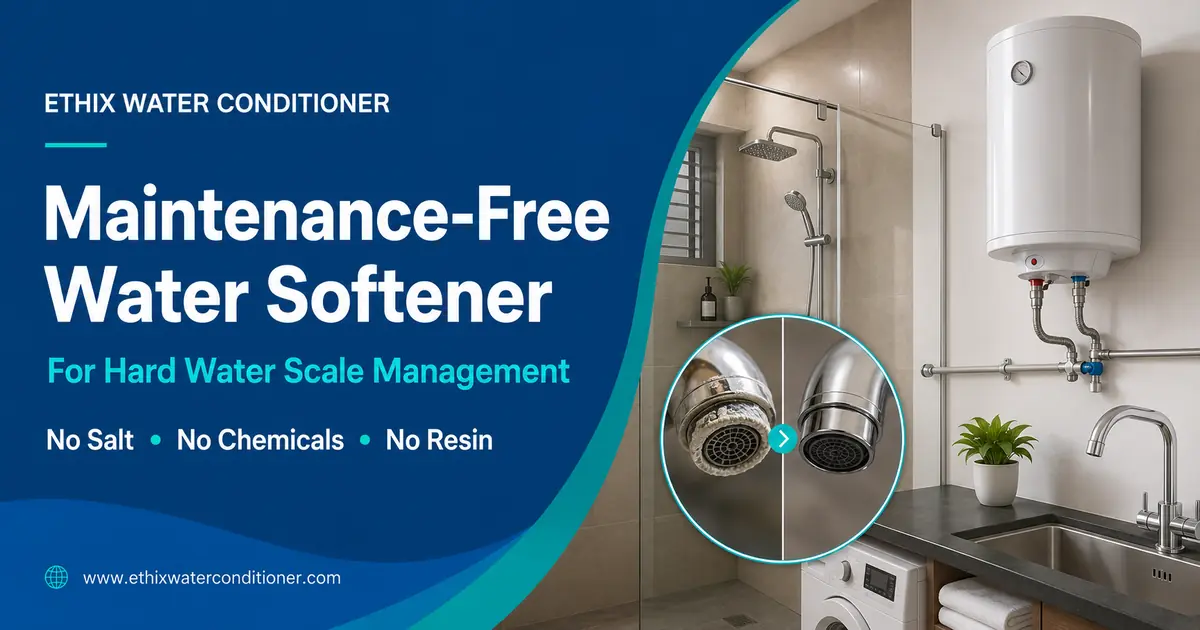
Hard water can leave white scale on taps, tiles and showerheads and may contribute to deposits inside geysers, pipelines and water-using equipment. It is therefore natural to search for a maintenance-free water softener. Before choosing a system, however, it is important to understand that a traditional water softener and a salt-free water conditioner do different jobs.
A conventional ion-exchange softener removes calcium and magnesium and produces measurably soft water, but it normally requires resin, salt regeneration, a drain connection and routine monitoring. A salt-free conditioner is intended for scale management without softener-style regeneration. It retains hardness minerals, so it should not be represented as producing zero-hardness water.
For actual hardness reduction, choose a correctly designed ion-exchange softener. If the priority is managing hard-water scale without regular salt filling, chemical dosing, resin regeneration or brine discharge, Ethix Water Conditioner may be considered as a maintenance-free, salt-free alternative. Ethix does not reduce TDS or measured hardness.
1. Common Signs of Hard Water at Home and Work
Hardness mainly refers to dissolved calcium and magnesium in water. The severity and type of deposit also depend on alkalinity, pH, temperature, evaporation, water use and other dissolved substances. A laboratory water report is more reliable than judging hardness from a TDS meter alone.
Bathroom deposits
White marks may repeatedly appear on taps, showerheads, glass partitions and tiles.
Reduced water flow
Deposits in aerators, shower nozzles and narrow passages may affect spray or flow.
Hot-water scaling
Geysers, solar heaters and heating surfaces can require more frequent inspection and cleaning.
Appliance concerns
Washing machines, dishwashers and other connected equipment may show scale or residue.
Hardness and TDS are not the same. TDS is a combined estimate of dissolved substances. A TDS meter cannot identify calcium and magnesium separately, and lower TDS does not automatically mean soft water.
2. What Is a Maintenance-Free Water Softener?
The phrase maintenance-free water softener is widely used online, but it can describe very different technologies. A true salt-based water softener uses ion-exchange resin to replace hardness ions, usually with sodium or potassium ions. Once the resin becomes exhausted, the system regenerates using brine. Salt must be refilled, settings monitored and the resin and control valve maintained.
Many products described as salt-free or maintenance-free are technically water conditioners or scale-management systems, not conventional softeners. They are designed to influence scale behaviour without removing the hardness minerals. Because there is no softener resin or brine regeneration, routine operating work can be significantly different.
“Maintenance-free” should not mean “inspection-free”
Even when a conditioner requires no salt, chemical dosing or replaceable resin media, the complete water system should still be inspected. Pumps, electrical supply, filters, tanks, plumbing, valves and connected equipment may have their own maintenance requirements. Water should also be retested when its source or quality changes.
3. Traditional Water Softener vs Ethix Water Conditioner
| Comparison point | Traditional ion-exchange softener | Ethix Water Conditioner |
|---|---|---|
| Main purpose | Physical reduction of calcium and magnesium hardness | Salt-free hard-water scale management |
| Measured hardness after treatment | Reduced when correctly sized and operated | Not reduced; hardness minerals remain |
| TDS reduction | No; a softener is not an RO system | No; Ethix is not an RO system |
| Salt requirement | Regular salt or potassium refill normally required | No salt refill required |
| Resin / media | Ion-exchange resin required | No softener resin or replaceable conditioning media |
| Regeneration | Periodic brine regeneration required | No softener-style regeneration cycle |
| Drain and wastewater | Regeneration discharge must be planned | No brine-regeneration wastewater from the conditioner |
| Routine operating attention | Salt, brine tank, valve settings and resin performance | No salt filling, resin regeneration or chemical dosing; system checks still recommended |
| Best fit | Projects that require demonstrably lower hardness and soft-water characteristics | Projects prioritising scale management with low routine intervention |
If a tender, process or customer specification requires a particular outlet hardness, a properly engineered softener may be necessary. If the verified problem is recurring scale and the goal is a salt-free approach, a conditioner may be the more relevant category.
4. How Ethix Provides a Maintenance-Free Hard Water Solution
Ethix Water Conditioner is designed for users seeking a salt-free, chemical-free and media-free approach to hard-water scale management. It is installed on the selected pipeline so that water passes through the conditioning unit before reaching the priority plumbing or equipment.
Key operating advantages
- No regular salt filling: there is no brine tank to refill.
- No softener resin regeneration: no regeneration schedule or resin-based exchange cycle is used.
- No routine chemical dosing: the conditioning process does not depend on adding treatment chemicals.
- No softener-style brine discharge: there is no regeneration wastewater from the unit.
- Minerals remain in the water: calcium and magnesium are not removed.
- Main-line installation: model and location can be selected for homes, societies, commercial properties, agriculture and industrial applications.
5. How to Choose the Right Water Softener for Hard Water
Start with the required outcome, not only the product name. This avoids buying a conditioner when measurable soft water is essential—or installing a full salt-based softener when the main priority is low-maintenance scale management.
- Test the water: check total hardness, calcium, magnesium, TDS/conductivity, pH, alkalinity, iron, manganese and suspended solids as relevant.
- Define the goal: decide whether you require lower measured hardness, reduced scale behaviour, drinking-water treatment or particle removal.
- Record system details: note pipe size, pump HP, peak flow, daily water consumption, storage capacity and water source.
- Select the installation point: assess the borewell outlet, tank inlet, tank outlet or main distribution line according to system operation.
- Check connected equipment: identify geysers, solar heaters, boilers, cooling towers, laundry machines or irrigation lines that require protection.
- Measure results correctly: use agreed indicators such as hardness at the outlet for a softener, or deposit behaviour and cleaning frequency for a conditioner.
Where can Ethix Water Conditioner be used?
- Homes, flats, villas and bungalows
- Apartment complexes and housing societies
- Hotels, hospitals and commercial buildings
- Factories, pipelines and selected industrial equipment
- Farms, borewell lines and irrigation systems
- Geysers, solar water heaters and water-using appliances
Frequently Asked Questions
Is there a completely maintenance-free water softener?
A conventional ion-exchange softener normally needs salt replenishment, regeneration and periodic servicing. A salt-free conditioner can avoid those softener-specific tasks, although the overall plumbing and water system should still be checked.
Does Ethix Water Conditioner reduce water hardness?
No. Ethix does not remove calcium and magnesium and does not reduce the laboratory hardness value. It is designed for salt-free scale management.
Does a maintenance-free water conditioner reduce TDS?
No. TDS reduction normally requires a suitably designed process such as reverse osmosis. Ethix does not reduce TDS.
Does Ethix require salt, chemicals or resin?
Ethix does not require routine salt filling, chemical dosing or ion-exchange resin regeneration.
Can Ethix be installed for borewell hard water?
It may be suitable for borewell scale-management applications. Selection depends on the water report, pipe size, pump capacity, flow, storage and the required result.
Is a water conditioner the same as a water purifier?
No. A conditioner is not a drinking-water purifier and does not remove microbes or all contaminants. Test the water and add suitable filtration, RO or disinfection where required.
Which Ethix model do I need?
The correct model and installation point depend on pipe diameter, pump HP, peak flow, application, water source and daily use. Share these details for technical selection.
Technical note: Always select treatment from a representative water report and the required outlet-water specification.