
Water quality guide
How to Test Water Hardness at Home: Start with the Right Test
White deposits on taps, scale inside a kettle and soap that struggles to lather can point to hard water. But those observations cannot tell you the hardness level. Before choosing a treatment system, measure the water itself. [1]
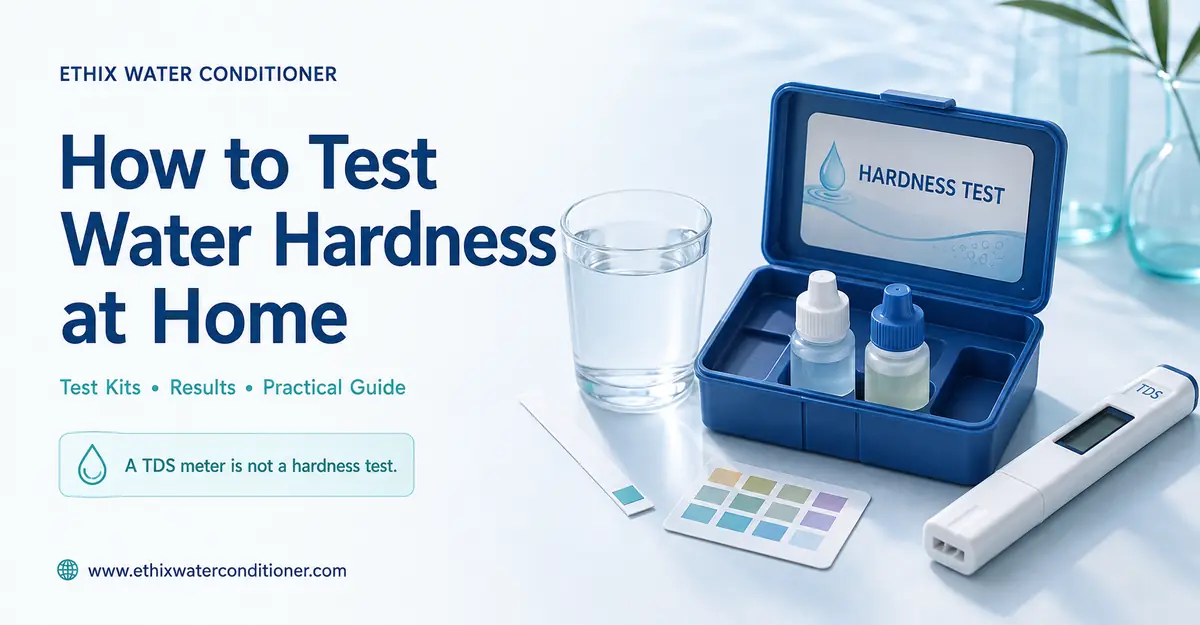
To test water hardness at home, use a total-hardness test strip or a drop-count hardness kit and follow its instructions. Look for results reported as mg/L as CaCO3. Strips give an approximate range; a suitable drop-count kit provides a numerical result at the kit’s stated resolution. A standard TDS pen is not a hardness test. [2] [3]
Which water hardness test should you choose?
Choose according to the decision you need to make. A quick screening result and a detailed treatment-design report serve different purposes.
| Method | What it tells you | Main limitation |
|---|---|---|
| Total-hardness strips | An approximate hardness band from a colour chart. | Not an exact value; check the strip’s range and reading time. |
| Drop-count hardness kit | A hardness result calculated using the kit’s stated factor. | Sample volume, endpoint and calculation must match that kit. |
| Laboratory analysis | The parameters requested, which can include total hardness. | A hardness-only report is not a complete drinking-water assessment. |
| Standard TDS pen | An estimate of dissolved solids based on conductivity. | Does not separately measure calcium and magnesium hardness. |
Method references: Hach [2], EPA [3] and CDC [4]. On a small screen, swipe the table to read every column.
What does a water hardness result measure?
Water hardness mainly reflects dissolved calcium and magnesium. Laboratories commonly express the result as an equivalent amount of calcium carbonate: mg/L as CaCO3. This is a reporting convention, not a measurement of visible chalk particles floating in the water. [1]
For an Indian home using borewell, tanker, municipal or mixed water, write down the source and sampling point alongside the reading. A kitchen sample taken after an RO purifier answers a different question from an untreated sample supplying the bathrooms.
Why a TDS meter cannot replace a hardness test
A standard TDS pen estimates dissolved solids from electrical conductivity; it does not identify the individual dissolved ions. You therefore cannot convert its reading directly into a reliable calcium-and-magnesium hardness value. [3]
For the detailed difference, read our Hard Water vs TDS guide. Use this article to choose and carry out a dedicated hardness test.
- Water source and collection point.
- Whether the sample is before or after an existing treatment unit.
- Test date, kit name, result and units shown on the label.
- The problem you are investigating, such as kettle scale or tap deposits.
How to Carry Out a Water Hardness Test at Home
Use the following steps as a practical checklist alongside the instructions supplied with your kit. Dip time, sample volume, reagent quantities and calculation factors are not interchangeable between products.
Prepare the kit and choose your sampling point
- Check the label: choose a total-hardness test, check its expiry date and make sure its measuring range suits the sample. A calcium-only test or an alkalinity test is not the same measurement.
- Choose the water you want to assess: for bathroom scale, sample the supply serving that bathroom. Do not substitute water from a separate drinking-water RO outlet.
- Use the specified test vessel: prepare and rinse it as the kit instructions require. Avoid detergent residue and do not add cleaning chemicals to the sample.
- For a laboratory sample: ask the laboratory which bottle, collection method and delivery time it requires. Do not rinse a supplied bottle unless instructed; it may contain a preservative.
Follow the kit’s safety instructions for handling and disposal. Keep reagents away from children and food, use any specified protective equipment, and never drink a tested sample.
Method 1: Use a total-hardness test strip
- Take a fresh strip without touching its test pad. Close the pack as directed.
- Expose the pad to your sample for the time stated on the label. Follow the instructions about draining or shaking off water.
- At the specified reading time, compare the pad with that product’s own colour chart in good light.
- Record the colour band and units. If the result is at the top of the scale, treat it as a range limit—not proof that the actual hardness equals that printed value.
Test strips are useful for screening, but colour bands should not be reported as precise laboratory measurements. A strip with a narrow low-hardness range may not be suitable for untreated hard water. [5]
Method 2: Use a drop-count hardness kit
- Measure the exact sample volume specified for the range you are using.
- Add the kit’s buffer and indicator in the stated amounts and order, where required.
- Add the titrant as directed, counting the drops and mixing between additions. Stop at the colour endpoint described by the manufacturer.
- Calculate hardness using the factor for that kit and sample volume. Keep the units with the result.
For example, if a kit specifies 17.1 mg/L as CaCO3 per drop, a count of 10 drops corresponds to 171 mg/L as CaCO3. This is an illustrative calculation, not a universal factor or an Ethix customer test result. [6]
Can you test hardness with soap instead?
A soap-lather comparison can be a rough observation, but it does not provide a dependable hardness value. Soap formulation and the amount used affect what you see. Do not assign a ppm number—or select equipment—by counting bubbles. Use a hardness-specific test for a measured result.
Water Hardness Chart: What Does Your Result Mean?
Compare a total-hardness result reported as mg/L as CaCO3 with this general USGS classification. The table uses whole-number ranges as published by USGS. [1]
| Hardness: mg/L as CaCO3 | Classification |
|---|---|
| 0–60 | Soft |
| 61–120 | Moderately hard |
| 121–180 | Hard |
| Above 180 | Very hard |
These are descriptive hardness categories, not BIS drinking-water limits or a pass/fail safety certificate. For a decimal result near a boundary, retain the reported value and consider the test’s uncertainty.
A simple example
Suppose your laboratory reports total hardness of 240 mg/L as CaCO3. That falls in the “very hard” category. A separate TDS reading of 240 ppm does not establish the same hardness. Always check the parameter name, not just the number.
Check the units before comparing two reports
In dilute freshwater, hardness stated as ppm as CaCO3 is approximately equivalent to mg/L as CaCO3. Some kits use grains per US gallon: 1 gpg = 17.1 mg/L as CaCO3. Neither conversion turns a TDS reading into a hardness result. [6]
- Was the sample from the water line that actually has the problem?
- Is the result a measured value, a colour band or an above-range reading?
- Are you trying to remove hardness, manage scale or make water safe to drink?
- Does the proposed equipment address that specific requirement?
A hardness category alone does not select a machine. Flow rate, daily water use, other water-quality parameters and the equipment’s operating limits also matter.
What Should You Do After Testing?
Start with the result and the problem—not a product name. A hardness-removal system, a scale-management device and a drinking-water purifier have different jobs.
| Your requirement | Treatment direction to assess | Important check |
|---|---|---|
| Reduce measured calcium and magnesium hardness | An appropriately sized ion-exchange water softener. | Check capacity, salt use, regeneration, drainage and maintenance. |
| Manage scale in suitable utility-water lines | A scale-management approach, which may include a water conditioner. | Check application suitability and evidence; do not assume hardness removal. |
| Reduce dissolved contaminants in drinking water | A treatment system, potentially including RO, selected for the test results. | Confirm the specific contaminants the system is designed to reduce. |
| Address microbial contamination | Appropriate disinfection and any necessary pre-treatment. | A hardness test or scale conditioner does not establish microbial safety. |
| Remove mud or suspended sediment | Suitable sediment filtration. | A basic sediment filter does not remove dissolved hardness. |
General treatment references: CDC [4] and Penn State Extension [7]. Final selection requires the actual water report and application details.
Where does Ethix Water Conditioner fit?
Ethix Water Conditioner is designed for salt-free scale management in suitable plumbing and utility-water applications. It is not a drinking-water purifier and does not reduce TDS like an RO system. Where a specified reduction in measured hardness is required, an ion-exchange softener may be more suitable.
Share your water report, pipe size, flow rate, daily consumption and visible scale issue before selecting an Ethix model. Explore Ethix residential water-conditioning solutions. Model suitability and expected performance should be assessed for the site.
Frequently Asked Questions
Can a TDS meter measure water hardness?
No. A standard TDS pen estimates dissolved solids from conductivity; it does not separately measure calcium and magnesium hardness. Use a dedicated hardness test. [3]
Is a test strip enough before buying a system?
A strip is a useful first check. If you need equipment sizing, an exact target or a drinking-water assessment, obtain the appropriate laboratory measurements rather than relying only on its colour band.
Does “very hard” mean the water is unsafe to drink?
Not by itself. Hardness classification is not a complete safety assessment. Drinking-water suitability depends on the relevant chemical and microbial test results, not hardness alone. [4]
Should I test before or after my RO purifier?
To assess the water feeding bathrooms or the whole home, test that supply. To check a purifier, label its inlet and outlet samples separately. A kitchen RO outlet may not represent the bathroom supply.
Will Ethix lower the hardness or TDS number?
Ethix is intended for scale management, not a specified reduction in laboratory-measured hardness or TDS. Do not treat a TDS change as the sole test of a scale-management system’s performance.
When should I repeat a hardness test?
Repeat it if the water source changes, a result is inconsistent or you need to check a treatment goal. For a useful comparison, record the sampling point, method, units and treatment status each time.
- U.S. Geological Survey: Hardness of Water — definition, reporting units and general classification.
- Hach: Water Hardness Measurement — hardness-specific measurement methods.
- U.S. EPA-hosted technical reference: Conductivity and Water Quality (PDF) — conductivity does not identify individual ions.
- CDC: About Home Water Treatment Systems — choose treatment for the contaminants of concern.
- Hach: Test Strips and example manufacturer reading-time instructions (PDF) — use the chart, range and timing supplied with your own kit.
- Hach HA-71A Total Hardness Test Kit Manual (PDF) — example of range-specific drop-count instructions and hardness unit conversion.
- Penn State Extension: Water Softening — hardness removal and softener considerations.
These independent educational references are not endorsements of Ethix. Product scope is described in Ethix’s Hard Water vs TDS guide. This article does not certify any individual water supply as safe to drink.
4 thoughts on “How to Test Water Hardness at Home: A Practical Guide”