Ethix Hard Water Guide | India
Hard water problems can appear in homes, housing societies, hotels, factories and irrigation systems. White deposits on taps, reduced soap lather, scale inside geysers and blocked spray nozzles are familiar examples. What begins as a minor cleaning issue can become a recurring maintenance concern, especially in water systems that heat, circulate or evaporate large volumes of water.
This guide explains how hard water affects different types of water systems, how to identify the cause and which treatment options may help. It also explains when an Ethix salt-free water conditioner may be considered—and when a conventional softener, filter or RO system is needed instead.
What Causes Hard Water Problems?
Hard water contains dissolved calcium and magnesium, usually picked up as water moves through mineral-rich soil and rock. The amount varies by location and water source. Borewell water may have substantial hardness, but municipal or tanker water can also be hard. You cannot determine hardness from clarity or a TDS reading alone.
When water is heated or concentrated through evaporation, certain dissolved minerals can form deposits on surfaces. Scale on a heating element or inside a pipe is different from sand, rust or biological fouling, so the correct treatment depends on what is actually present.
What is a hard water reading?
A laboratory often reports total hardness as mg/L (or ppm) as calcium carbonate, CaCO3. A commonly used USGS classification is shown below. These are reference categories, not a prediction of the exact scale you will see at every site.
| Classification | Hardness as CaCO3 | What it means |
|---|---|---|
| Soft | 0–60 mg/L | Relatively low calcium-magnesium hardness |
| Moderately hard | 61–120 mg/L | Some hardness-related effects may be noticeable |
| Hard | 121–180 mg/L | Scale and soap-performance concerns may be more likely |
| Very hard | Over 180 mg/L | Greater hardness-related deposit potential in many applications |
For independent background, see the USGS explanation of water hardness. To interpret your own measured value, try the Ethix water hardness calculator.
Seven Common Signs of Hard Water in Daily Life
1. White marks on taps and bathroom tiles
Chalky marks often appear when water evaporates and leaves mineral deposits behind. Cleaning removes existing stains; choosing suitable treatment may help with further deposits. Not every white mark is caused solely by hardness.
2. Reduced soap lather and soap scum
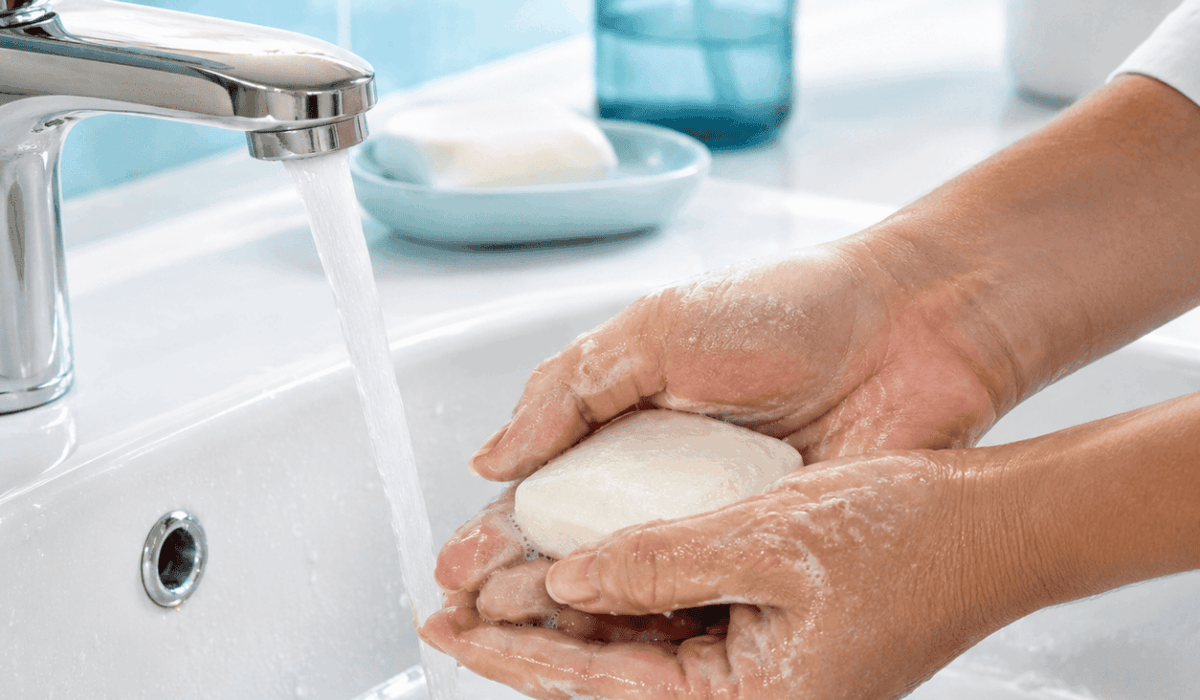
Calcium and magnesium can react with soap, making lather less effective and leaving residues on washbasins, showers and fabrics. Detergent formulation and dose also influence the result.
3. Scale in geysers and solar water heaters
Hot-water equipment may accumulate deposits on heating surfaces. Heavy scale can interfere with heat transfer and increase servicing needs. Actual energy or cost effects depend on the equipment and amount of scale; a conditioner should not be sold with a guaranteed electricity-saving claim.
4. Blocked showerheads and fittings
Mineral deposits can narrow small openings in showerheads, aerators and valves. A blocked outlet can also result from sediment or rust, which may require filtration rather than scale conditioning.
5. Low water flow in older pipelines
Internal scale can contribute to restricted flow. Before deciding on equipment, confirm whether the underlying cause is mineral buildup, a pump problem, pipe design or another blockage.
6. Laundry and washing-machine concerns
Hardness can affect soap performance, leaving fabrics feeling rough and contributing to deposits on some machine parts. Where measurably softer water is needed for washing or a specified process, an ion-exchange softener may be the appropriate choice.
7. Skin and hair feel different after washing
Some people notice residue, dryness or a rougher hair feel in hard-water areas, but experiences vary and these symptoms have many possible causes. A salt-free conditioner does not remove hardness minerals, so improvements to skin, hair or shampoo lather should not be promised.
Hard Water Problems in Homes, Societies, Commercial Buildings, Industry and Agriculture
The treatment objective changes with the application. A homeowner concerned about white stains is not asking for the same water quality as a boiler operator who must meet a strict hardness limit.
Homes, flats and bungalows
Typical concerns include bathroom stains, shower deposits, scale in geysers and washing-machine issues. The right installation point depends on the borewell or municipal supply, pipe size, pump HP and tank arrangement.
Housing societies and apartments
Central pumping lines and shared water networks can develop recurring scale complaints. Model selection requires flow, storage and tank-refill details; a common-line system must be evaluated for actual plumbing coverage.
Hotels, hospitals and commercial properties
Guest-room fittings, hot-water circuits, laundry and service equipment may have different requirements. A salt-free conditioner may be considered for selected lines; laundry or process water that requires verified lower hardness may need a resin softener.
Factories and industrial utilities
Heat exchangers, cooling towers, boilers and process equipment need application-specific water chemistry and operating targets. A conditioner must not be assumed to replace boiler pretreatment, corrosion control or cooling-tower chemical and microbiological controls.
Agriculture and irrigation
Drip emitters and sprinkler nozzles may block because of carbonate scale, sediment, iron or biological fouling. Testing the source water helps distinguish these causes before choosing filtration, cleaning or scale-focused treatment.
Borewell and mixed-water systems
Seasonal changes, tanker mixing and tank storage can alter water quality. Test hardness and relevant contaminants before sizing a solution. TDS and hardness should be checked separately.
Which Treatment Helps With Hard Water Problems?
There is no one-size-fits-all treatment. Decide first whether you need a lower hardness reading, help with scale deposits, a reduction in dissolved salts, or removal of particles and contaminants.
| Technology | What it does | When to consider it |
|---|---|---|
| Ion-exchange water softener | Exchanges hardness ions, reducing measurable calcium-magnesium hardness; normally needs salt-brine regeneration | Laundry, boiler pretreatment or processes requiring a specified lower hardness value |
| Ethix salt-free water conditioner | Designed to help reduce scale deposits; does not remove dissolved hardness minerals or reduce TDS | Suitable pipelines and water systems where scale deposits are the main concern |
| Reverse osmosis (RO) | Reduces many dissolved constituents with a membrane; needs appropriate feed-water quality and maintenance | Drinking or process water where dissolved-solids reduction is justified by a water report |
| Sediment / multimedia filtration | Removes suspended particles, not dissolved calcium or magnesium hardness | Sand, mud, turbidity and particulate blockage |
| Iron removal or other specialist treatment | Addresses identified contaminants under appropriate design conditions | Iron stains, odour or other separately measured water-quality issues |
For more detail on the two scale-related approaches, read hard water conditioner vs softener and the Ethix ion-exchange softener guide.
How Ethix Water Conditioner May Help With Hard Water Scale
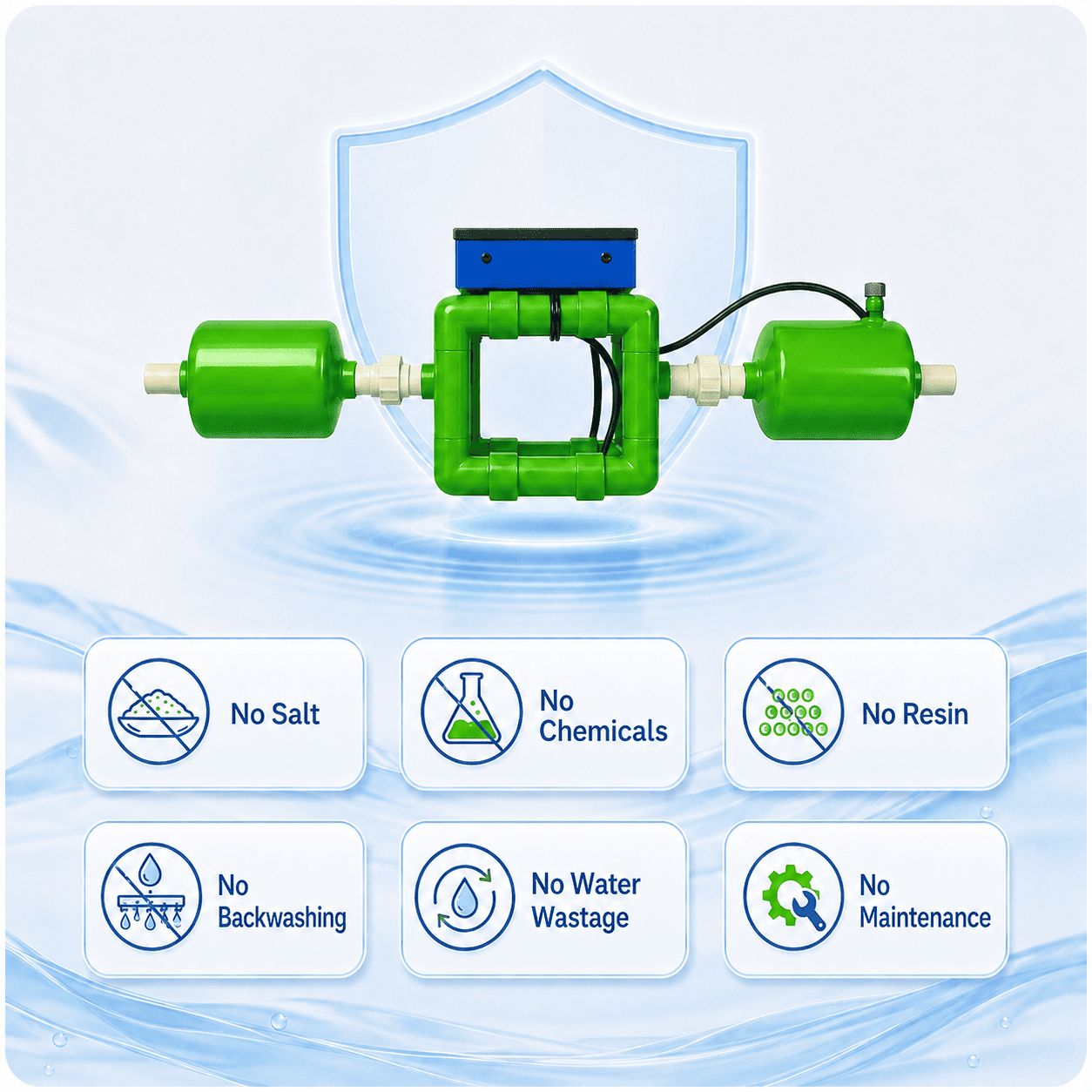
Ethix Water Conditioner is a salt-free, chemical-free conditioning product intended to help reduce mineral-scale deposits in suitable water lines. Ethix describes its system as combining electrolysis, electronic and electromagnetic stages. These are the company's stated design stages; performance should be assessed for the particular water quality and application rather than assuming a guaranteed result.
Unlike an ion-exchange softener, the conditioner does not use a resin bed or regular brine regeneration. It also does not remove calcium or magnesium from the water, reduce TDS, make unsafe water drinkable or eliminate the need to clean heavy existing deposits. The conditioner itself is designed for no routine salt, resin or media replacement; installation, electrical safety and site inspections still matter.
Where should the machine be installed?
Possible positions include a borewell or pump outlet, main incoming line, overhead-tank inlet or suitable tank outlet. The best point depends on tank refill frequency, hydraulic layout, flow, pump HP, pipe size and water source. Do not select a location solely because it is closest to the bathroom or kitchen.
What should you send for a product recommendation?
- Water source and recent hardness report
- Pipe diameter at the proposed installation point
- Pump HP, approximate flow and daily consumption
- Tank capacity and refill cycle
- Application: home, society, hotel, industrial system or irrigation
- Description and photos of the scale or blockage problem
Five Practical Ways to Reduce Hard Water Problems
- Test the water. Measure total hardness separately from TDS, and check iron, turbidity or other concerns where relevant.
- Identify the deposit. Mineral scale, sediment and corrosion are different issues.
- Clean existing deposits. Descale suitable taps, showerheads or equipment according to manufacturer instructions.
- Check equipment requirements. Boilers, RO membranes and industrial processes may have mandatory feed-water limits.
- Choose and size treatment correctly. Match the technology and installation to the objective, flow, pipe size and source.
Frequently Asked Questions About Hard Water Problems
What are the most common hard water problems at home?
White deposits on taps, scale in geysers, reduced soap lather, showerhead blockage and increased cleaning are common signs. Confirm the cause with a hardness test.
Can hard water damage pipes and appliances?
Scale deposits can restrict some pipes and affect heating surfaces and water-using equipment. The degree of impact depends on water chemistry, temperature, flow and maintenance.
Is 300 ppm hardness considered very hard water?
Yes. When the result is 300 mg/L as CaCO3, it is above the commonly used 180 mg/L threshold for very hard water.
Does a TDS meter measure water hardness?
No. A handheld TDS meter usually estimates total dissolved solids from conductivity; it does not separately measure calcium and magnesium hardness.
Does Ethix Water Conditioner reduce hardness or TDS?
No. Ethix is intended to help reduce scale deposits. It does not remove dissolved calcium or magnesium hardness and does not reduce TDS.
Can Ethix be used in housing societies or agriculture?
It may be considered where mineral-scale deposits are the target problem. Selection requires water testing and a review of flow, pipe size and the installation arrangement.
What if my boiler or RO plant needs low-hardness water?
Follow the equipment maker's feed-water specification and design appropriate pretreatment. Do not assume a salt-free conditioner can meet a specified hardness limit.
Need Help With Hard Water Scale?
Tell the Ethix team about your water source, pipe size, pump capacity, daily water use and scale problem. We can help review whether a conditioner or a different treatment direction suits your installation.
Reference: USGS Water Science School — Hardness of Water. This is an educational water-hardness reference, not an endorsement or performance validation of Ethix equipment.