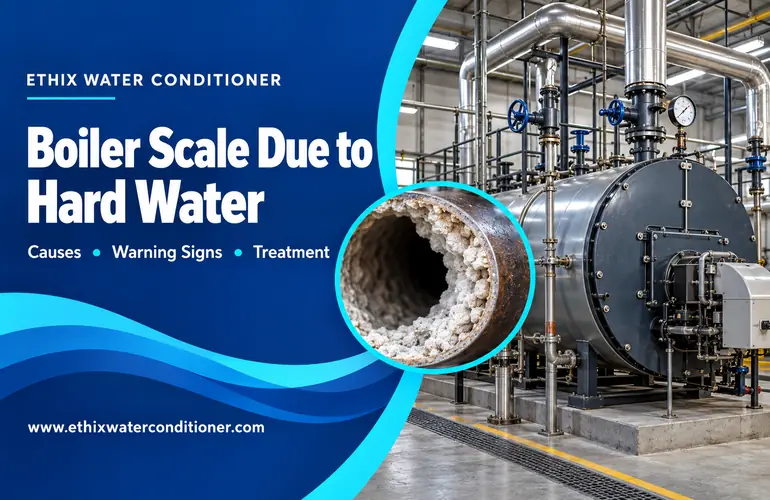
Boiler Scale Due to Hard Water: Causes, Warning Signs and Treatment
A practical guide for plant, utility and maintenance teams dealing with scale-prone borewell, tanker or mixed-source water.
Quick answer
Hard water can form calcium- and magnesium-based deposits on boiler heat-transfer surfaces. That layer acts as insulation, so more heat may be needed to produce the same steam output; severe deposits can also contribute to tube overheating and failure. The correct response is not chosen from TDS alone. It requires water chemistry, boiler pressure and load, make-up rate, condensate return, blowdown control and deposit identification. Depending on the duty, the treatment train may include filtration, ion-exchange softening, RO or demineralisation, chemical treatment, deaeration, controlled blowdown and professional cleaning.
What Is Boiler Scale—and Why Does Hard Water Cause It?
Boiler scale is a hard, adherent deposit that forms on water-side surfaces where heat must pass into the boiler water.
Hardness is mainly associated with dissolved calcium and magnesium. These minerals may remain in solution in cool source water, but a boiler changes the conditions: water is heated, steam leaves the vessel and dissolved substances become concentrated. When solubility limits and local chemistry are exceeded, mineral salts can precipitate onto tubes and other hot surfaces.
Calcium carbonate is a familiar hardness deposit, but a boiler deposit can be more complex. Calcium phosphate, magnesium compounds, silica, iron oxides, corrosion products and suspended matter may appear alone or together. This is why a white or stone-like layer should be analysed rather than automatically labelled “hard-water scale.”
Hardness and TDS are not the same. A handheld TDS meter estimates total dissolved material from conductivity; it does not separately measure calcium and magnesium. Read Ethix’s Hard Water vs TDS guide before using a TDS number to select treatment.
How the deposit develops
- Make-up water introduces hardness, alkalinity, silica and other dissolved or suspended constituents.
- Steam production leaves most non-volatile minerals behind, increasing their concentration in the boiler water.
- Heat, pH, pressure and concentration shift the water chemistry and encourage precipitation.
- Particles attach to heat-transfer surfaces and can harden into an insulating layer.
- If control remains inadequate, the deposit becomes thicker and cleaning intervals shorten.
Why Boiler Scale Deserves Early Attention
A boiler may continue producing steam while its waterside condition slowly worsens. The operational penalty often appears as a trend, not a single alarm.
Lower heat transfer
Scale adds thermal resistance between the flame or hot gas and the boiler water.
Higher energy demand
More fuel may be required to maintain steam output when heat-transfer surfaces are fouled.
Metal overheating
Insulated tube metal can run hotter, raising the risk of distortion or premature failure.
More shutdown work
Inspection, descaling and unplanned maintenance can interrupt production and increase cost.
The U.S. Department of Energy notes that deposits act as insulation and reduce heat transfer across boiler tubes. Its guidance recommends tracking stack temperature under comparable firing conditions and consulting a water-treatment specialist when scale is found.
Safety note: Boiler operation, inspection and chemical cleaning are specialist activities. Follow the boiler manufacturer’s limits and applicable Indian safety requirements. Never open, dose, isolate or clean a pressurised or hot boiler without an approved procedure and authorised personnel.
Eight Warning Signs Plant Teams Should Track
No single symptom proves hardness scale. Compare the current condition with a clean, stable operating baseline and look for a consistent pattern.
Rising stack temperature
A gradual increase at similar load and excess oxygen can indicate poorer heat transfer.
Higher fuel per tonne of steam
Normalise fuel use against steam production before drawing a conclusion.
Slower pressure recovery
The boiler takes longer to respond to a comparable steam demand.
Reduced steaming capacity
Output falls even though the burner and load conditions appear similar.
Hot spots or tube distress
Inspection identifies local overheating, bulging, cracking or repeat tube problems.
Hard deposit during shutdown
Adherent material is visible on tubes, plates or accessible water-side surfaces.
Shorter cleaning interval
Deposits return sooner after each clean despite similar production conditions.
Unstable boiler-water results
Hardness leakage, conductivity or treatment residuals drift outside the control band.
These signs can also result from soot, burner imbalance, corrosion, oil contamination, poor blowdown control, sensor error or changing production demand. Confirm the cause before changing the water-treatment programme.
What Should Be Tested Before Choosing a Solution?
A useful boiler investigation connects laboratory results with actual operating data.
| Check | Why it matters | Where to measure or record |
|---|---|---|
| Total and calcium hardness | Identifies major scale-forming hardness and softener leakage. | Raw water, treated make-up and feedwater as required |
| pH and alkalinity | Affect carbonate chemistry, treatment control and corrosion risk. | Make-up, feedwater and boiler water per programme |
| Conductivity / TDS | Helps track overall concentration; it is not a hardness test. | Make-up and boiler water, with calibrated instruments |
| Silica, iron and chlorides | May reveal non-hardness deposits, carryover or corrosion concerns. | Laboratory analysis based on boiler pressure and duty |
| Dissolved oxygen / treatment residuals | Supports corrosion and chemical-programme control. | At sampling points specified by the treatment specialist |
| Make-up and condensate return | High make-up continuously introduces fresh minerals and treatment demand. | Metered daily or shift-wise volume |
| Blowdown and cycles | Shows whether dissolved solids are being controlled without unnecessary energy loss. | Manual or automated blowdown records |
| Deposit composition | Distinguishes hardness scale from silica, iron, corrosion products or contamination. | Representative deposit sample during shutdown |
| Fuel, steam and stack data | Provides a trendable performance baseline. | Comparable load, firing rate and excess oxygen |
Sample points, test frequency and control limits must suit the boiler design, operating pressure, metallurgy and chemical programme. High-pressure or process-critical systems require tighter, specialist-controlled water quality than a small low-pressure heating boiler.
Boiler Scale Prevention and Treatment Options Compared
There is no single device for every boiler. In many plants, several controls work together as one treatment train.
| Option | Primary role | Important planning point |
|---|---|---|
| Strainer / multimedia filtration | Controls suspended solids, silt and debris. | Does not remove dissolved calcium and magnesium. |
| Ion-exchange softener | Removes calcium and magnesium hardness from make-up water. | Needs salt, regeneration, brine management and hardness monitoring. |
| RO or demineralisation | Reduces dissolved minerals where stricter feedwater quality is required. | Requires pretreatment, membrane/resin control and reject or regeneration planning. |
| Chemical treatment | Controls scale, corrosion and sludge within a designed programme. | Dosing, residuals and compatibility must be monitored by a qualified specialist. |
| Deaeration / oxygen control | Reduces dissolved gases that contribute to corrosion. | Does not replace hardness removal or deposit control. |
| Controlled blowdown | Limits concentration of dissolved and suspended solids. | Too little invites deposits or carryover; too much wastes water, heat and chemicals. |
| Condensate return | Reduces fresh make-up demand and recovers useful heat. | Returned condensate must be monitored for contamination. |
| Physical scale conditioning | Provides a salt-free scale-management approach for selected lines and duties. | Does not reduce measured hardness or TDS and does not replace specified boiler treatment. |
| Mechanical / chemical cleaning | Removes existing accessible deposits. | Use deposit analysis, material compatibility and an approved OEM/specialist procedure. |
Existing heavy scale is a maintenance problem, not merely a product-selection problem. It may need professional cleaning before a preventive programme can be evaluated. Acid cleaning performed without deposit analysis and metallurgy checks can cause serious damage.
A Practical Five-Step Action Plan
Build a clean operating baseline
Record steam output, fuel use, make-up volume, condensate return, stack temperature, blowdown and water-test results at stable load.
Test each relevant water stream
Test raw, treated make-up, feedwater, condensate and boiler water as specified. A source-water report alone cannot confirm treatment performance.
Identify the deposit
Use inspection and representative analysis to distinguish hardness scale from silica, iron oxide, sludge, corrosion products or process contamination.
Review the complete treatment train
Check pretreatment capacity, softener leakage, chemical dosing, deaeration, blowdown, condensate recovery and operator sampling—not just one component.
Verify the result with trends
After corrective work, compare normalised energy and water data, deposit recurrence and inspection findings over a meaningful operating period.
Where May Ethix Water Conditioner Fit?
Ethix Water Conditioner is positioned as a salt-free, chemical-free scale-conditioning system for selected industrial utility-water applications. For a boiler site, possible placement should be assessed on the raw-water, common utility or make-up-water side only after reviewing the source, flow, pipe size, treatment train and boiler requirements.
Information Ethix should review
- Water source and current laboratory report
- Boiler type, capacity and operating pressure
- Make-up flow, daily volume and pipe size
- Existing softener, RO/DM and chemical programme
- Condensate return, blowdown and visible deposit history
What it must not be presented as
- Not a hardness-removal softener
- Not a TDS-reduction or RO system
- Not a replacement for chemical treatment or deaeration
- Not a substitute for blowdown, monitoring or cleaning
- Not a universal solution for silica, iron or corrosion deposits
Important: Do not install any device directly on a hot, pressurised or safety-critical boiler connection without written engineering approval. Final placement must follow the boiler OEM, water-treatment specialist and site safety team.
Explore the Ethix industrial water conditioner page for application-planning details, or compare related problems in heat exchangers and cooling towers.
Industrial Boiler Water Planning Across India
Factories in Pune, Mumbai, Nashik, Ahmedabad, Vadodara, Surat, Delhi NCR, Jaipur, Indore, Nagpur, Hyderabad, Bengaluru, Chennai, Coimbatore and Kolkata may receive very different water even within the same industrial estate. Borewell depth, tanker source, municipal blending and seasonal changes can alter hardness, alkalinity, silica and TDS.
For food processing, textiles, pharmaceuticals, hospitals, hotels, laundries, engineering plants and other steam users, treatment should be designed from a current site sample and real operating data. A model selected only from city name, motor HP or a single TDS reading is not a sound boiler-water decision.
Common Mistakes That Delay the Real Fix
- Choosing from TDS alone: conductivity cannot tell you the calcium and magnesium hardness or identify a deposit.
- Treating every deposit as limescale: silica, iron oxides, sludge and corrosion products require different controls.
- Ignoring softener leakage: a softener that regenerates but leaks hardness is not protecting the boiler.
- Overlooking make-up water: leaking steam traps or poor condensate return increase fresh mineral loading.
- Using blowdown as the only cure: blowdown controls concentration but can waste energy if it is not matched to chemistry.
- Cleaning without analysis: the wrong acid, concentration or contact time can attack tubes, welds and fittings.
- Expecting a conditioner to replace treatment: a salt-free conditioner does not remove hardness or satisfy an OEM feedwater specification by itself.
- Comparing unnormalised fuel bills: production load, fuel quality, ambient conditions and condensate return can distort the comparison.
Frequently Asked Questions
Can hard water damage an industrial boiler?
Yes. Calcium- and magnesium-based scale can reduce heat transfer and contribute to tube overheating. The actual risk depends on water chemistry, boiler pressure, heat flux, make-up rate and treatment control.
Can a TDS meter detect boiler feedwater hardness?
No. A TDS meter estimates overall dissolved content from conductivity. A dedicated hardness test is needed to measure calcium and magnesium hardness or confirm softener leakage.
Does boiler blowdown remove existing scale?
No. Blowdown helps control the concentration of dissolved and suspended material in boiler water; it does not reliably remove hard, attached deposits. Existing scale may require specialist mechanical or chemical cleaning.
Is a water softener always required before a boiler?
Not every boiler has the same specification, but hardness removal is common in boiler make-up treatment. The correct choice may involve softening, RO, demineralisation or another designed train based on pressure, chemistry and OEM limits.
Does Ethix Water Conditioner reduce hardness or TDS?
No. Ethix is presented as a salt-free scale-conditioning option for selected applications. It does not remove calcium and magnesium hardness and does not reduce TDS like an RO or demineralisation system.
Can Ethix replace boiler chemicals, deaeration or blowdown?
No. It should not replace the boiler manufacturer’s feedwater specification, chemical programme, deaeration, blowdown, monitoring, cleaning or safety controls. Suitability and placement require technical review.
What information is needed for an industrial application review?
Share the water source and report, boiler type and pressure, make-up flow, daily consumption, pipe size, existing treatment, condensate return, blowdown method, deposit history and installation photographs.
How can a plant confirm that corrective action is working?
Trend hardness leakage, boiler chemistry, fuel per tonne of steam, make-up water, condensate return, stack temperature and deposit recurrence under comparable operating conditions. Inspection evidence is more reliable than one isolated reading.
Review Your Boiler Make-Up Water Before Scale Becomes a Shutdown
Send Ethix your latest water report, boiler capacity, operating pressure, make-up flow, pipe size, current treatment details and deposit photographs for an initial application discussion.
Technical references and further reading
- U.S. Geological Survey: Hardness of Water — calcium, magnesium and water-hardness fundamentals.
- U.S. Department of Energy: Best Management Practice #8—Steam Boiler Systems — treatment, monitoring, blowdown and condensate-return guidance.
- U.S. Department of Energy: Clean Firetube Boiler Waterside Heat-Transfer Surfaces — deposit, stack-temperature and inspection guidance.
- Spirax Sarco: Water Treatment, Storage and Blowdown for Steam Boilers — boiler hardness, scale and water-treatment fundamentals.