Hard Water Filter for Tap: How to Choose the Right Solution
Hard Water Filter for Tap: Why Do White Scale Marks Appear?
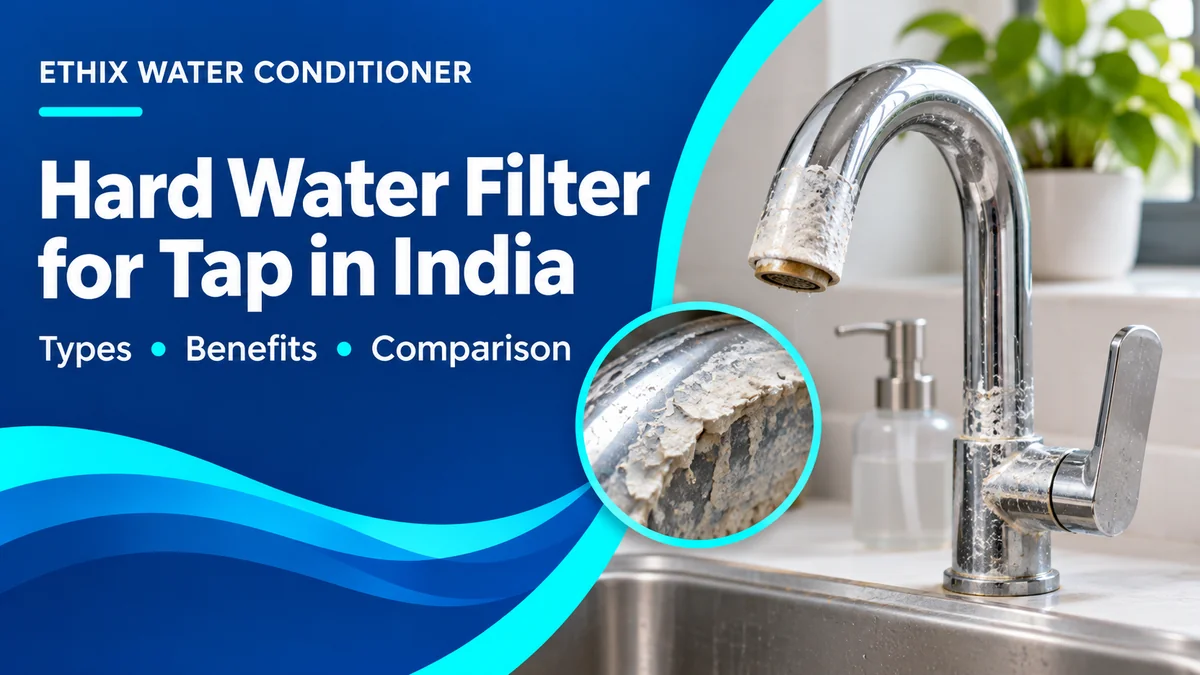
Hard water contains dissolved minerals, mainly calcium and magnesium. As water evaporates from a tap or shower surface, some minerals can remain behind. When droplets dry on chrome taps, tiles or shower glass, minerals can remain as white deposits. Heated water can also encourage scale buildup inside geysers and certain appliances. That is why a single household may experience white stains in the bathroom, reduced shower flow and more frequent descaling.
For that reason, if white marks led you to search for a hard water filter for tap fittings, test the hardness before choosing a product. Scale often reflects dissolved minerals rather than sediment that a simple cartridge can catch.
However, one point many online listings miss is that hardness is not the same as TDS. A handheld TDS meter estimates total dissolved ions, not calcium-and-magnesium hardness alone. For accurate treatment planning, request a total hardness test in mg/L as CaCO3.
| Water hardness | Measured hardness (mg/L as CaCO3) | What it means |
|---|---|---|
| Soft | 0–60 | Low mineral hardness |
| Moderately hard | 61–120 | Some scale risk, depending on use |
| Hard | 121–180 | Deposits can be more noticeable |
| Very hard | Over 180 | Higher potential for mineral scale concerns |
Classification source: U.S. Geological Survey — Hardness of Water. These are general reference ranges, not a substitute for water-system design.
White marks on taps
Water droplets dry and leave mineral residue on metal and glass.
Showerhead deposits
Scale can build up around small spray holes and fittings.
Laundry concerns
Hardness can affect detergent use and washing-machine scale.
Hard Water Filter for Tap: Which Type Should You Buy?
At first glance, any product labelled a hard water filter for tap might seem capable of turning hard water into soft water. In practice, the filter media and verified performance matter much more than the words on the packaging.
For sand, dust or rust particles
For sand or visible particles, start with a correctly rated sediment filter. Although it captures suspended solids, it generally cannot remove dissolved hardness minerals.
For chlorine-related taste or smell
If chlorine-related odour is the concern, consider a carbon filter tested for that specific contaminant. Importantly, a carbon cartridge is not the same as a hardness-removal system.
For measurable calcium and magnesium reduction
Instead, choose a verified ion-exchange cartridge or a properly sized water softener when you need measurable hardness reduction. Before buying, check capacity, flow, inlet hardness and regeneration or replacement requirements.
For recurring scale throughout a connected plumbing line
In that situation, consider upstream treatment instead of replacing small faucet cartridges repeatedly. If the goal is scale conditioning rather than softening, assess an inline conditioner with a specialist.
Hard Water Filter for Tap vs Softener vs Ethix Conditioner
These are different treatment categories. Consequently, choosing the wrong one can leave the original water problem unresolved even after installation.
| Solution | What it does | Reduces hardness? | Best use |
|---|---|---|---|
| Sediment tap filter | Captures suspended particles | No | Sand, dust, rust particles |
| Carbon tap / shower filter | Reduces specified substances, often free chlorine | Usually no | Tested chlorine, taste or odour concerns |
| Ion-exchange softener | Exchanges calcium and magnesium ions | Yes | Actual water softening |
| Reverse osmosis | Removes many dissolved constituents using membranes | Yes, when correctly designed | Selected drinking-water / process needs |
| Ethix Water Conditioner | Designed to help reduce adherent hard-water scale deposits | No | Suitable scale-conditioning applications |
For a broader look at softening, conditioning and water quality, explore Ethix's hard water solution guide for India.
Shower Head Filter for Hard Water: What Actually Works?
A shower head filter for hard water may be useful when you want to reduce a particular substance, but you should first check what the cartridge is actually tested to remove. For example, NSF/ANSI 177 shower-filter certification addresses free available chlorine reduction; it does not, by itself, prove calcium-and-magnesium hardness removal.
A hard water filter for tap use and a shower filter can look similar online, but neither product category guarantees soft water. Compare independently supported reduction claims, not just marketing descriptions.
What about a shower filter for hard water in India?
First, check your local water source and pressure. A household using borewell water may need a different approach from a flat receiving treated municipal supply. Shower attachments can be useful for the substances they are designed to treat, but a cartridge should not be called a water softener without hardness-reduction evidence.
Hard water filter for bathroom: think beyond the showerhead
If deposits also appear on the bathroom tap, mixer and geyser line, a shower attachment alone will not address every connected fitting. In that case, assess a suitable bathroom inlet treatment point. Ethix's Bramhastra Series is designed for selected bathroom, kitchen, geyser and compact utility water lines where scale-related conditioning is the goal. It does not filter contaminants or soften water.
Read the related guide: White stains on bathroom tiles — causes and solutions.
Hard Water Filter for Washing Machine: What Actually Helps?
In washing machines, hardness minerals may contribute to scale on water-contact parts, especially during heated cycles. They can also change how efficiently detergent works. However, white residue on clothes can have other causes, including excessive detergent or poor rinsing, so avoid diagnosing hardness from stains alone.
For example, a washing-machine sediment inlet filter catches some particles, but it will not normally soften water. If you need lower total hardness, compare correctly sized ion-exchange softeners. By contrast, a properly installed conditioner may be considered for scale control without expecting reduced TDS or hardness readings.
For cleaning, testing and appliance-specific checks, see Hard Water in Washing Machine: Signs, Causes & Solutions.
Hard Water Filters for Home: Tap, Tank or Whole House?
A hard water filter for water tank and a hard water filter whole house system are not automatically the same thing. Instead, the treatment point depends on the water source, tank location, hydraulic flow and which household fittings need coverage.
Therefore, when one hard water filter for tap use cannot address scale concerns at other fixtures, evaluate the shared plumbing layout before choosing a central system.

When a single tap filter makes sense
For a problem isolated to one outlet, choose point-of-use filtration only when the device is rated for the identified contaminant.
When a whole-house system makes more sense
By contrast, if taps, showers, geysers and washing areas share the same hard-water supply, central treatment may cover more of the plumbing. A whole-house softener lowers hardness; a central conditioner focuses on scale-related performance. Neither should be substituted for a needed purifier or disinfection process.
What about overhead or underground tanks?
Similarly, storage tanks do not automatically remove dissolved hardness. A sediment filter may be useful where particles are present, while softening or conditioning must be designed around pump flow, tank arrangement and distribution. Tank hygiene and disinfection remain separate considerations.
Ethix Water Conditioner: Salt-Free Scale Conditioning
Ethix Water Conditioner, made by Emerging Ethix Power Pvt. Ltd. in Pune, is designed to help reduce scale deposits in suitable water lines. Unlike conventional softeners, it does not require salt regeneration or routine resin replacement. The company describes its approach as combining electrolysis, electronics and electromagnetic treatment.
Nevertheless, the distinction matters: Ethix is not a faucet filter, an RO purifier or an ion-exchange softener. It does not reduce TDS or dissolved calcium and magnesium. Actual performance may vary with water chemistry, flow, installation and existing deposits.
Bramhastra Series
For selected bathroom, kitchen, geyser and small utility lines.
Delta Series
For suitable independent homes, flats, villas and residential water lines.
Delta Plus Series
For higher-flow society, commercial and other selected applications.
What details should you share before choosing a system?
- Location and property: City, apartment, bungalow, housing society or commercial premises.
- Water source: Borewell, municipal, tanker or mixed supply.
- Water report: Total hardness, TDS and any other known water-quality issues.
- Plumbing: Pipe size, pump HP, tank arrangement and approximate daily usage.
- Main concern: White stains, hot-water scale, shower blockage or appliance scaling.
For context on how the units work and where they may be placed, see the Ethix installation and working-process overview.
7 Smart Tips Before Buying a Hard Water Filter for Tap
Test before buying
To begin, use a reliable water report that includes total hardness. Check sediment and other parameters if they are part of the complaint.
Define the result you want
Next, define whether your priority is removing particles, reducing a specified contaminant, lowering hardness ppm or addressing scale deposits.
Match the treatment to the location
For instance, a tap, a shower, a washing-machine inlet and a whole-house line all have different flow rates, installation points and service requirements.
Ask for the right proof
When comparing softeners, request inlet and outlet hardness results as well as resin capacity. Filter suppliers should share independent contaminant-reduction data and cartridge ratings. For a conditioner, ask for relevant scale-performance evidence under comparable water and operating conditions.
Review lifetime operating requirements
Also include salt, regeneration, cartridges, electricity, cleaning, plumbing and service where applicable—rather than comparing only purchase prices.
Check your actual water flow
Because flow limits vary widely, a compact tap cartridge, shower fitting and household supply line are not interchangeable. Confirm the rated flow and pressure before purchasing a device.
Avoid claims that do not match the technology
Finally, ask whether the product removes particles, reduces hardness in mg/L or aims to affect scale formation. Do not accept a TDS-reduction promise from equipment that does not remove dissolved salts.
Hard Water Filter for Tap: Frequently Asked Questions
Tap, Shower and Washing-Machine Questions
1. Which is the best hard water filter for tap in India?
The best choice depends on the problem. A sediment filter helps with particles, a certified carbon filter may reduce chlorine, and an ion-exchange softener removes hardness minerals. Ethix is a separate scale-conditioning option for suitable plumbing applications.
2. Can a tap filter turn hard water into soft water?
Only if it uses effective hardness-removal technology, such as suitably rated ion-exchange media. Ordinary carbon and sediment filters do not normally remove dissolved calcium and magnesium.
3. Does a shower head filter for hard water remove calcium?
Do not assume so. Many shower filters target free chlorine or particulates instead. Look for independent inlet/outlet hardness testing before treating a shower filter as a softener.
4. Do I need a hard water filter for washing machine use?
First check the water hardness and appliance instructions. Sediment inlet filters do not normally soften water; a suitably designed softener can lower hardness, while a conditioner may be evaluated for scale concerns.
5. What is the difference between a bath filter and whole-house treatment?
A bath or shower filter treats one outlet. A whole-house system may serve several connected lines, including taps, showers, geysers and washing areas, depending on the actual plumbing layout.
Whole-House Water Treatment and Ethix Questions
6. Will a hard water filter for tank reduce hardness?
Not unless it includes a genuine hardness-removal process. Tank storage and sediment filtration alone do not eliminate dissolved hardness minerals.
7. Does Ethix reduce TDS or hardness ppm?
No. Ethix Water Conditioner is intended to help reduce hard-water scale deposits in suitable systems. It does not remove dissolved hardness minerals and does not reduce TDS.
8. Which Ethix model is suitable for my bathroom or complete home?
Bramhastra may suit selected bathroom or small-line use; Delta may suit a residential main line; and Delta Plus serves suitable higher-flow applications. The final recommendation depends on water source, pipe diameter, pump, flow and intended coverage.
9. How do I confirm if my water is hard?
Request a total hardness test reported in mg/L as CaCO3. White marks can be a clue, but a TDS meter alone is not a hardness test.
10. Are salt-free conditioners the same as water softeners?
No. Ion-exchange water softeners actually lower hardness by removing calcium and magnesium ions. Salt-free scale conditioners have a different intended purpose and should not be claimed to produce laboratory-soft water.
Which Hard-Water Treatment Should You Buy?
Before ordering a hard water filter for tap, decide what you actually need the device to change. Where dirt enters the faucet, suitable filtration can help. Measurable calcium and magnesium reduction calls for a correctly sized softener. Meanwhile, households dealing mainly with repeated scale across connected fittings may evaluate an appropriately selected conditioner such as Ethix.
Ultimately, choose the solution that matches your water test results, plumbing and expected outcome, rather than the one with the longest feature list.
Not Sure What Your Home Needs?
Tell the Ethix team your city, water source, pipe size and main scale concern. We can help assess whether a suitable water-conditioning model fits your application, or whether you need another form of water treatment.
Emerging Ethix Power Pvt. Ltd. · Pune, Maharashtra, India · [email protected]
- U.S. Geological Survey — Hardness of Water (what water hardness measures and reference bands).
- NSF — Shower Filter Certification (scope of shower-filter certification).
- Ethix Delta Series product information (intended use and conditioner limitations).