INDUSTRIAL WATER GUIDE
A heat exchanger can look healthy from the outside while mineral deposits are quietly building on the surfaces that matter most. For factories, process plants, hotels, hospitals and commercial facilities using hard borewell or mixed-source water, that hidden layer can mean weaker heat transfer, higher pressure loss and more frequent shutdowns for cleaning.
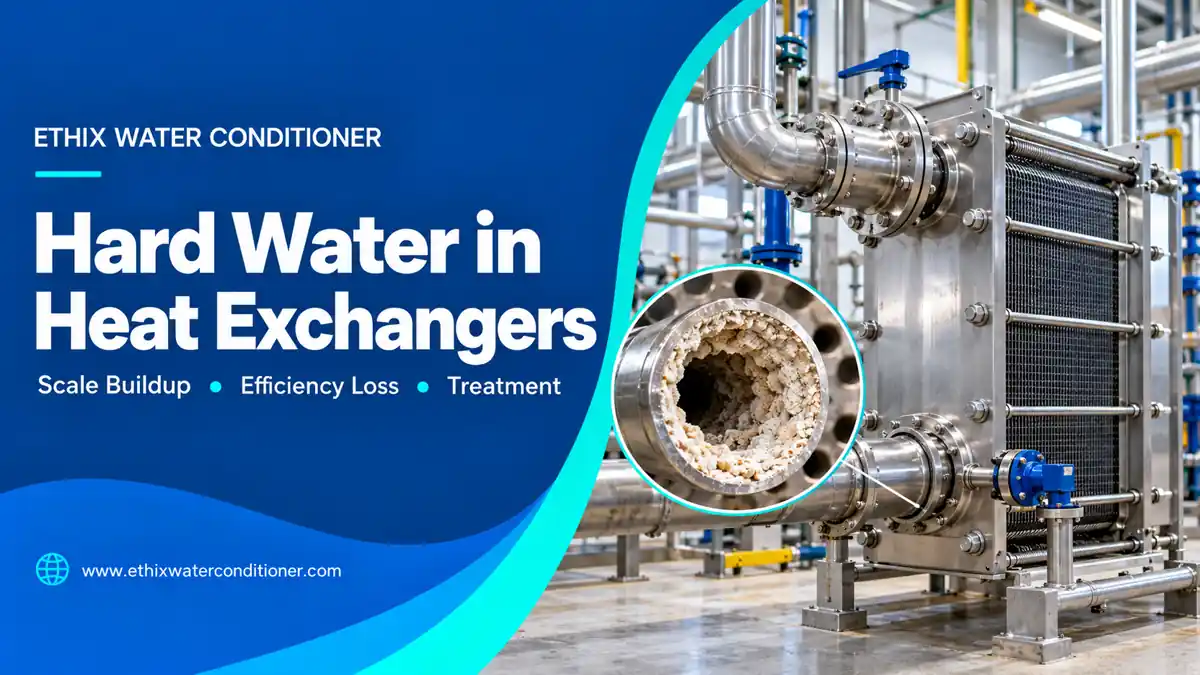
Hard water in heat exchangers can form calcium- and magnesium-based scale on plates, tubes and water passages. The deposit acts as a barrier to heat transfer and may also narrow the flow path. The right response starts with a water test and operating data; treatment may involve filtration, controlled chemistry, softening, membrane treatment, scale conditioning, cleaning—or a site-specific combination.
What Does Hard Water Do Inside a Heat Exchanger?
Water hardness is mainly associated with dissolved calcium and magnesium. These minerals may be harmless in many everyday uses, but conditions change inside heat-transfer equipment. When water chemistry, temperature, concentration and residence time favour precipitation, mineral salts can form a hard deposit on metal surfaces.
In a plate heat exchanger, scale can collect along narrow channels and on the plate surface. In a shell-and-tube unit, it may build inside tubes or on the water-side surface. Condensers, chillers, oil coolers, process heaters and cooling-water circuits can face the same underlying problem when scale-forming water reaches the equipment.
Scale is only one type of fouling
A deposit is not automatically a hardness problem. Suspended solids, corrosion products, oil, process contamination and biological growth can also foul a heat exchanger. This distinction is important because each cause needs a different corrective action. A hardness conditioner cannot replace a strainer for grit, a separator for oil or a biological-control programme for an open cooling circuit.
Seven Warning Signs of Heat Exchanger Scale
Do not wait for a blocked exchanger before investigating. Compare current performance with the clean-equipment baseline and look for a pattern across these indicators:
Outlet temperature or approach temperature moves away from the normal target at a comparable load.
Pump discharge, differential pressure or flow behaviour suggests narrowing passages.
The system needs more cooling water, steam, fuel or compressor work to deliver the same duty.
Heating or cooling takes longer even though production conditions have not materially changed.
The interval between descaling or clean-in-place cycles becomes shorter.
Hot spots, unstable control or inconsistent product temperatures appear during operation.
White, off-white or stone-like material is found during inspection or cleaning.
None of these signs proves hardness scale by itself. Confirm the cause with deposit analysis, water chemistry and operating records before changing the treatment programme.
What Should Be Tested Before Selecting a Solution?
A TDS meter cannot diagnose water hardness or predict exchanger scaling on its own. TDS is a combined estimate of dissolved substances; it does not separately report calcium, magnesium, alkalinity or silica. Start with a laboratory water analysis and connect the result to real operating conditions.
| Check | Why it matters | Useful record |
|---|---|---|
| Total and calcium hardness | Shows the concentration of major scale-forming hardness minerals. | mg/L as CaCO3 |
| pH and alkalinity | Help assess carbonate-scale tendency under operating conditions. | Source and circulating water |
| Conductivity/TDS | Helps track overall dissolved-mineral concentration, especially in recirculating systems. | Make-up and return water |
| Silica, iron and chlorides | May indicate other deposit or corrosion risks that hardness alone cannot explain. | Laboratory report |
| Turbidity and suspended solids | Identify particulate fouling that may need filtration. | Raw and treated water |
| Temperature and flow | Influence precipitation, shear, residence time and equipment performance. | Design and actual values |
| Pressure drop and temperatures | Trend data can reveal deterioration before a shutdown becomes necessary. | Clean baseline versus current |
For an open recirculating system, also record make-up water, blowdown, evaporation and cycles of concentration. For a process-critical exchanger, follow the equipment manufacturer’s water-quality limits and the plant’s metallurgy, corrosion and hygiene requirements.
If the only reading available is TDS, read Hard Water vs TDS before selecting equipment.
Heat Exchanger Water-Treatment Options Compared
There is no universal device for every deposit, exchanger and water source. The best treatment train addresses the measured cause and the process requirement.
| Option | Primary role | Planning consideration |
|---|---|---|
| Strainer or filtration | Controls suspended particles and debris. | Does not remove dissolved hardness. |
| Chemical water treatment | Can manage scale, corrosion and biological risk in suitable systems. | Needs correct dosing, monitoring and compatibility control. |
| Ion-exchange softener | Removes calcium and magnesium hardness. | Uses salt and regeneration; brine handling and operating control are required. |
| RO or demineralisation | Reduces dissolved minerals for processes with strict water specifications. | Needs pretreatment, membrane/resin management and reject or regeneration planning. |
| Physical water conditioning | Provides a salt-free scale-conditioning approach for selected applications. | Does not reduce measured hardness or TDS; suitability depends on water and system design. |
| Mechanical or chemical cleaning | Removes existing deposits and restores accessible surface area. | Cleaning method must suit the deposit, plate/tube material, gasket and OEM procedure. |
Where Does Ethix Water Conditioner Fit?
Ethix Water Conditioner is designed for salt-free, chemical-free scale conditioning in selected industrial water applications. Ethix combines three stages—Electrolysis, Electronics and Electromagnetic treatment—and can be considered for heat exchanger water lines, cooling circuits, condenser lines and other scale-prone utility systems after application review.
Scale-conditioning support without conventional salt regeneration, routine chemical dosing or resin media.
It does not reduce TDS, remove calcium and magnesium from the water, purify drinking water or replace every industrial treatment process.
On a suitable site, the installation point may be the main incoming line, borewell/raw-water outlet, cooling-tower make-up line or a dedicated utility line upstream of the exchanger. Final placement and model selection depend on flow rate, pipe diameter, pump details, water chemistry, temperature, recirculation and equipment layout.
Information needed for an Ethix application review
- Water source: borewell, municipal, tanker, recycled or mixed supply
- Recent water-analysis report and visible deposit details
- Heat exchanger type, duty and equipment manufacturer’s water limits
- Pipe size, line material, flow rate, operating hours and pump data
- Inlet/outlet temperatures, pressure drop and recirculation arrangement
- Existing filtration, chemicals, softener, RO/DM plant and cleaning history
Explore the Ethix Industrial Water Conditioner, the Delta Plus Series and the Ethix Scale Jammer for industrial application information.
Planning for Industrial Hard Water Across India
Industrial plants in India often combine borewell, municipal, tanker and recovered water. Quality can change by source, season and even by borewell within the same industrial estate. A solution selected only by city name or TDS reading is therefore unreliable.
Ethix supports industrial enquiries across India, including manufacturing and commercial hubs around Pune, Mumbai, Nashik, Ahmedabad, Vadodara, Surat, Rajkot, Bengaluru, Hyderabad, Chennai, Coimbatore, Delhi NCR, Jaipur, Indore, Nagpur and Kolkata. Wherever the plant is located, responsible selection begins with the site’s own water report, flow conditions and equipment requirement—not a generic regional assumption.
Facilities using evaporative cooling should also read Hard Water in Cooling Towers, because exchanger performance and cooling-water management are often connected.
A Practical Action Plan for Plant and Facility Teams
- 1Establish the baseline.
Record design duty, clean pressure drop, inlet/outlet temperatures and normal flow. - 2Test the right water.
Sample the source, make-up and circulating water where relevant; do not rely on TDS alone. - 3Identify the deposit.
Separate mineral scale from silt, corrosion products, oil and biological fouling. - 4Restore heavily fouled equipment.
Use an OEM-approved cleaning method before assessing a preventive programme. - 5Match treatment to the requirement.
Compare filtration, chemistry, softening, membranes and physical conditioning against measured needs. - 6Verify with trends.
Monitor temperatures, pressure drop, energy/utility use and cleaning interval after implementation.
Frequently Asked Questions
What causes hard-water scale in a heat exchanger?
Scale forms when dissolved minerals—commonly calcium compounds—precipitate under favourable water-chemistry and operating conditions, then attach to plates, tubes or other heat-transfer surfaces.
Does hard water reduce heat exchanger efficiency?
Mineral scale adds resistance between the process fluids and may restrict water passages. The result can be lower heat-transfer performance, higher pressure drop and greater utility demand.
How do I know whether the deposit is hardness scale?
Combine water analysis, deposit analysis and performance trends. Colour alone is not conclusive because silt, corrosion products, biological growth and process contamination can create similar symptoms.
Can a TDS meter measure water hardness?
No. A TDS meter estimates overall dissolved solids and cannot separately measure calcium and magnesium hardness. Use a hardness test or laboratory analysis.
Where should a water conditioner be installed for a heat exchanger?
Possible locations include the source-water outlet, make-up line or a dedicated utility line upstream of the exchanger. Correct placement depends on flow direction, recirculation, pipe size, pump arrangement and the wider treatment train.
Does Ethix Water Conditioner reduce hardness or TDS?
No. Ethix is designed for scale-conditioning applications. It does not remove calcium and magnesium, and it does not reduce the measured hardness or TDS of the water.
Can Ethix replace a softener, RO plant or chemical programme?
Not in every application. If the process requires mineral removal, a specified water chemistry, corrosion control, biological control or purified water, the appropriate treatment remains necessary. Ethix suitability should be reviewed as part of the complete system.
What details does Ethix need to recommend an industrial model?
Share the water source and analysis, equipment type, pipe size, flow rate, pump data, operating temperature, site layout, existing treatment and the main scale-related concern.
Discuss Your Heat Exchanger Application with Ethix
Share your water report, equipment type, pipe size, flow rate, operating temperature and current scale problem. The Ethix team will review the application and guide you towards a suitable model and installation point.
Technical reference note: Water hardness classifications and mineral definitions: U.S. Geological Survey. General heat-exchanger fouling and performance guidance: IPIECA and Alfa Laval. This article is educational and does not replace a laboratory water analysis, equipment-manufacturer instructions or site-specific engineering advice.